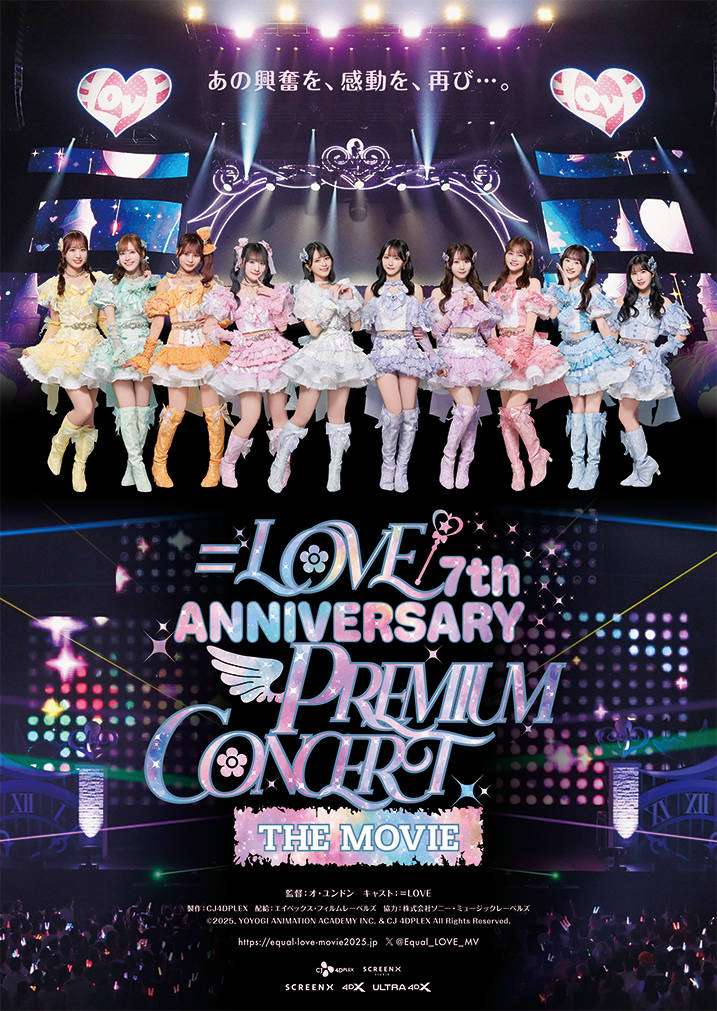
Recently, I’ve been trying to populate the data for a Japanese idol group’s page over at =LOVE - MusicBrainz . I’m currently at a crossroad deciding how punctuation should be used for this particular group, which is especially important for them as the group name begins (!) with a punctuation.
These are the issues that I would like to seek clarity and opinions on:
- Should we use full-width (=, U+FF1D) or half-width (=, U+003D) for the equal-sign at the start of the group name?
- For tracks/works with punctuation in the name, should we use full-width or half-width?
Regarding point number 1, the current style is to use the half-width symbol. This is also what the Japanese Wikipedia page uses for the header and url, although throughout the text, the full-width symbol is used interchangeably and with more occurrences. I am personally leaning towards using the full-width equal-sign, as it is the symbol used in their official webpage and every discography entry on their label’s page (at least to what I’ve seen thus far).
Regarding point number 2, I’ve seen the many different posts on this forum about punctuation (e.g., Space or no space between certain Japanese characters like "「」" and "~" , Style guide: use of punctuation full-width form - #4 by yindesu , A definitive answer on full-width vs. half-width punctuation? - #15 by hiro666 , Style guide: use of punctuation full-width form , etc.). There seems to be two main camps.
I find that the first camp is not the correct way to go. It would be presumptuous of us to enforce the JIS X 0213 standard onto the artists who do not follow it. Take the equal-sign in the name of the group as an example. The full-width equal-sign (U+FF1D) does not exist in the JIS X 0213 standard, but yet the group’s official page, their label, event posters, and even ticketing sites use it. However, I also have to note that the half-width, JIS X 0213 standard compliant, equal-sign is used on official streaming platforms such as their Spotify page, Apple Music page, YouTube Music page (although their regular YouTube channel doesn’t), and even on Wikipedia (as mentioned earlier). Therefore, I believe that, at least for this artist, punctuation are to be interpreted as artist’s intent and thus to follow the standard that the artist uses on their official discography/physical medium.
tldr; I suggest to use full-width punctuation for =LOVE on musicbrainz unless they use half-width punctuation on their official discography. What do you think?
2 Likes
I believe the main thing with most style questions is if there’s artist intent, we almost* always should follow that over standardizing. when there’s no clear artist intent, that’s where the style guidelines come in
*there are some minor exceptions, like moving featured artists from track titles to the artist credits or standardizing ASCII quotes ' to Unicode ’
since the official website and label page seem to be consistent, I would go with that
4 Likes
The first link shows both = FULLWIDTH EQUALS SIGN (U+FF1D) in the page content, but also = EQUALS SIGN (U+003D) in the window/tab title (<title>=LOVE Official Fan Club</title>).
The second link shows = (U+FF1D) indeed in release pages and also in texts, including their profile page text, but the profile main title shows = (U+003D), and also the site window/tab title again (<title>=LOVE | ソニーミュージックオフィシャルサイト</title>).
Their blog, quite similarly, uses = (U+FF1D) in texts but = (U+003D) in titles and user name…
So, they’re not 100% consistent, themselves. 
It’s true that I used to tend to use FULLWIDTH variants (parenthesis, exclamation and question marks) in full Japanese script titles, but maybe not in Latin script titles…
CJK punctuation, on the other hand, there is no discussion, is more the way to go for typical Japanese characters (nami dash, etc.). But that’s off-topic.
Good catch on the use of half-width equality symbol in the window/tab title. I did not notice that at all.
However, I believe that the reason why they used the half-width symbol there was for search engine indexing purposes, that is to say, so that it would be easier for the website to appear in the search engine results, especially when searched by foreign fans. The producer (creator) of the group was an early member of AKB and is aware of the positive (financial) impact of foreign fans when it comes to the idol business (see: https://www.news-postseven.com/archives/20150613_329132.html?DETAIL and AKB総選挙で指原が1位に、中国ネットでコメント続々=「納得できない!」「彼女推しは金持ちばかり」「今回の指原は実力」 for some examples). So, it was probably in the best of their interest to make it more accessible not only to the Japanese market, but also to the foreign market (my speculation). In that sense, “=LOVE” with the half-width symbol ought to be understood as a “search hint” alias for the group .
Moreover, the only version of the group name that can be naively copied from the official homepage without deliberately going into the page source is the full-width “=LOVE”. This suggests to me that the full-width “=LOVE” is the name of the group as explicitly intended by their producer. Therefore, this adds some support to my claim that the half-width “=LOVE” ought to be understood as an alias.
A former MusicBrainz user also tried to argue that we should use only full-width ASCII punctuation alongside half-width Latin script alphabet characters in Japanese titles/credits instead of using half-width for both. Why do you think a mix of typography in this manner would be more correct?
By the way, multiple official Sony sources use half-width, not full-width, for the name of the artist:
We know the intended punctuation is an equal sign (confirmed by the furigana) (so definitely not a double hyphen, which is also frequently misrepresented as a full-width equals sign). You’d have to do a lot more to prove that artist intent is that they intend to use U+FF1D instead of U+003D, and a reason that SonyMusic (their record company), SACRA MUSIC (their record label), and mora (their record company/label’s own digital music platform)'s usage of U+003D is all wrong.
One being easier to type than the other doesn’t show artist intent (and the fact that one is quicker to type than the other is the root cause of the inconsistency). Also,
It would be presumptuous of us to enforce the JIS X 0213 standard onto the artists who do not follow it.
Style / Miscellaneous - MusicBrainz is generally unpopular outside of MusicBrainz, but still exists.
Tangential reply about this:
It’s very much an edge case, but IMO, I would say that if there’s really explicitly stated artist intent about this, it should apply to the quotation marks too. I make music, and on at least one of my releases, there’s an ASCII apostrophe that is meant to be represented as such, and so a curly quotation mark I’d consider unambiguously wrong and a misspelling - I do think the Artist Intent style guideline would/should cover that. (I try to put a note in the annotation for such cases.)
2 Likes
I personally do not think that a mix of typography is good; it makes searching for the name harder. But, if the point of MusicBrainz is to be a source of truth, consistency in applying the style guidelines is necessary. And in applying the style guidelines to this specific group, we find that we should follow the artist’s intent.
So, what the question truly boils down to is “which equality symbol is the artist’s intention?” This problem, as you’ve pointed out, is hard to prove, because we’re not first-party participants privy to the conception and production of the group.
I’ve given some of my arguments why I believe that the full-width symbol U+FF1D is the artist’s original intent. And you are right in your counter-argument that Sony Music, SACRA MUSIC, and mora uses the half-width U+003D; even iTunes, Spotify, all the digital streaming sites that host their music do so too. However, as I’ve suggested earlier, the use of the half-width symbol here should be to make indexing/searching easier. Moreover, I noticed that even on those sites, there are explicit mentions of the group’s original name.
- In the profile page on the Sony Music site ( プロフィール | =LOVE | ソニーミュージックオフィシャルサイト ) and mora.jp ( =LOVE|音楽ダウンロード・音楽配信サイト mora ~WALKMAN®公式ミュージックストア~ ), which lists the group using the half-width U+003D, it is written:
指原莉乃プロデューサー自ら、グループ名を「=LOVE(イコールラブ)」とすることを発表しました。
- In the SACRA MUSIC page, it points to the group’s SNS pages. Most of which (https://www.instagram.com/equal_love.official/, https://x.com/equal_love_12, https://www.youtube.com/channel/UCv7VutirxDn3RWIJXI68n_A) use the full-width U+FF1D, except for Ameba Blog ( =LOVE Official Blog Powered by Ameba ). However, in the Abema blog posts by the group members (e.g. =LOVE『まいことのりおの4年間(のん乃案)』 ), we see that the full-width U+FF1D is used. This means that according to the members themselves, they’d use the full-width U+FF1D when referring to the group.
- Even on their sister group’s websites ( ABOUT ≒JOY| ≒JOY(ニアリーイコールジョイ)オフィシャルサイト ), we see the use of the full-width U+FF1D used when referring to the group. If they had intended for the group to be named using the half-width U+003D, they ought to have edited it here.
More crucially, I have found some other sources that corroborate the full-width U+FF1D as the artist’s intent:
- https://x.com/ululis_pr/status/1811048577113935892, in correcting their post (presumably about a official cosmetics tie-up with the group) where they “mistakenly” used the half-width U+003D instead of full-width “U+FF1D”.
- https://x.com/sadodo314/status/1952365527063834662, in a clip from a show where the members of the group are regulars of, they addressed this issue. The official stance is that the equality symbol in the group, is full-width! (It is mentioned at the very end of the clip; the two members that appeared on the show for this episode misspoke, and were corrected in the final, published cut.) (For future reference, this clip is from episode 96 of the show アイ=ラブ!げーみんぐ, aired on 2nd November 2024, at around the 13 min. mark.)
So, the answer to the question above is that the artist’s intent is indeed the full-width U+FF1D. As that is the case, following the style guidelines, we ought to follow their intent, and use the full-width U+FF1D in the name.
1 Like