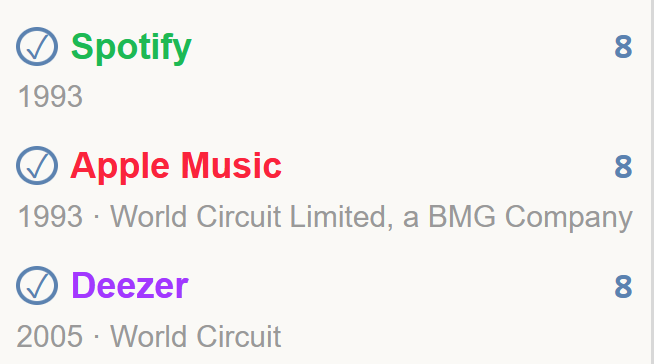
This one. If we could at least draw a line for reissues that are predating the shop that is selling it would take away some of the headache. Ditto the 1st Jan dates that are pointers to unknown release dates.
If a CD is released “early” from the band’s website as a promotion, then that is the release date. Even if the rest of the stores followed in later weeks. I can’t see why not do this with Digital too. Assuming the content is the same as the general availability release. A first release is still a first release.
But this can’t always be a case of “earliest date” as I’ve seen Bandcamp digital reissues showing the date of the original 1980s LP. There should be some intelligence in the algorithm.
I guess that is new? Nice to see. Would be good to follow that yellow standard. It makes editors actually stop and think then.
You can see some editors who use scripts don’t look at the data. They are easy to spot as there is no Release Type or Language filled in on their edits.
The MBS code referenced is declared in information.tt with ko if: target() && target().hasJanuaryFirstDate().
It looks for January 1st release dates (xxxx-01-01), and is indeed triggered on both a release-add and release-edit event.
In theory, it could possibly be expanded to watch for any release date prior to a specific date where the Packaging field is set to None, but there’s then the question of which date to use. A few confounding factors off the top of my head:
DSPs have existed prior to the advent of storefronts that are still around/well known, such as iTunes in 2001.
There are/were instances of pioneering artists that legitimately released music in the nascent days of the internet in the 90’s, such as the Internet Underground Music Archive, which opened in 1993.
There’s then the splitting of hairs if you factor in when specific modern DSPs opened in which countries, such as Deezer being available primarily only in France/Belgium from ~2007-2012.
Hi @rhetticent
First off, sorry I thought @chaban said that impossible (too early) release dates were already blocked by MBS, but he was speaking about featuring artists and 1st January releases.
I was more talking specifically about the importer userscripts, themselves (probably the root cause of many bad release dates):
When Deezer script imports from Deezer with a Deezer URL, it should not accept a release date that is before Deezer creation
Same for iTunes script
Same for Tidal script
Same for Spotify script
etc.
I should create tickets in all these bug trackers.
Maybe this was discussed somewhere before and I forgot: Deezer in particular seems to be better than many others for returning accurate release dates on digital reissues. (Although definitely not 100% accurate.) Sometimes it gives dates in the 2003–04 range which are not the original release date, but are also slightly before Deezer opened – I have never been sure, but I did wonder if these could still be accurate (i.e. the same digital release was available on a different platform starting from that date).
So there might be some reason to still allow dates from before store opening (at least from Deezer), but I would certainly agree that there should be some cut off date (around 2001 maybe?) before which it becomes too unlikely that the release was available digitally anywhere, and the importer should just ignore it.
Exactly, it’s why I say that Deezer importer userscript should not set release dates when Deezer shows a date when Deezer did not exist yet.
Same for each other importer userscripts ( iTunes, Tidal, Spotify, etc.).
And for Harmony importer (I think it’s a screenshot of Harmony), it should also know each site creation date and discard all impossible release dates.
In your screenshot, they should all be discarded, because:
Spotify did not exist in 93
Apple Music did not exist in 93
Deezer did not exist in 2005
So, Harmony should not import any release dates, in this case.
I don’t really mind if it just gets dropped anyway to be safe, but does anybody know where Deezer is getting this other date from? I don’t think it is necessarily wrong just because it’s from before Deezer was launched – they may have bought or inherited a database that already existed, or started building theirs over some period of time before launching. I have no idea if 2005(-11-22) is the correct date for the digital release, but it at least plausibly could be, since other major digital providers were operating by that point.
(To repeat: this is mostly curiosity. I would not object to ignoring the 2005 date anyway for being too unreliable, as should obviously be done for the 1993 ones.)
I am not sure the stance the @jesus2099 is taking here even correct. There are a huge number of such releases so it’s intentional. If you treat platform as a store, why does it matter when the store got the goods? The important part is when the goods are produced. Unless its a remaster, taking original production date is correct date to me.
I guess it comes from fnac.com.
Each physical edition website shop page used to give you the Deezer tracklist for you to play or preview, I don’t know.
Deezer must have taken the Fnac release dates from there.
Release dates from those specific physical editions (this between original release dates, because they are represses, and Deezer existence).
Streaming platforms will always want to show you original release dates (like our release groups), as it’s the only thing interesting when you show only one occurrence of each (like our release groups).
If we take only that for download/streaming releases, if we don’t want their actual digital (hidden) release date, then we would better stop cataloguing digital releases and just add their links to release groups or to original releases.
Especially streaming releases, I really don’t think we should try to catalogue them, they are just mimicking the discographies, just for listening purpose.
MB does not do this for any other media. Don’t confuse a recording date with a release date. CDs can go through many different factories over the years, and each change of production is a new release. New artwork, new release.
Something being format shifted from LP to CD is a new release.
This is the same with digital media. When something is format shifted from a CD to Digital Medai for the first time and sold in that new channel then that is a date worthy of note. And just like any other medium, if we don’t know the actual date that occurred then we should not guess.
Seeing 1970s albums with a Digital Release Date that matches the original LP is misleading and plain wrong. If you want that date, then you take it from the Release Group \ earliest release in the release group. Just like you would do if you wanted to date a reissued CD with the original album release date.
It is very jarring and clearly wrong to see a 1970s album as having a “first release” on Digital Media. Just as wrong as it would be to see a CD listed first.
Do keep in mind though that many releases on Deezer, do actually in fact predate Deezer. Many releases were on Amazon or iTunes. And when Deezer, Spotify, etc started that just received the already existing releases that were out there. But definitely shouldn’t have any digital media before 2000 and I’m seeing a ton. And as also pointed out, the -01-01, dates are obviously place holders when only the year is known. But yes, many dates are just wrong. I actually edited a digital release yesterday where the date was 1980 on a release that wasn’t recorded until 1990.