I know that harmony internally has the info when each of the streamers started, and AFAIK the plan was to use this to filter out dates that can’t be valid. But I don’t know what the state of this is. It’s part of the roadmap at Initial Roadmap · Issue #6 · kellnerd/harmony · GitHub
2 Likes
Oh, that’s a good idea.  In that case some of them might be ok because the digital edition was released to coincide with a physical reissue, and some of them are probably just whatever random date FNAC started selling something. So not seeding seems like a good idea.
1 Like
Much of that is probably cataloged wrong, but not all. There were websites with digital media before 2000 like Mod Archive - Wikipedia (1996 according to Wikipedia). BBSes were before my time, but I wouldn’t be surprised if there were MP3 releases on some of them in the early 1990s, and possibly mod/tracker file releases before that.
2 Likes
Please find some examples in the MB database. This is a very small minority of audio, but so little is actually here documented on MB. It is niche, gaming, sound effects, experimental.
MP3 needed an MP3 player… and back in the 1990s we were still mainly on dialup. Downloading music was hugely time consuming. Even downloading low res images would take minutes. Earliest music I remember collecting was late 1990s stolen rips of pirated CDs.
99.999% of the releases in the MB database with pre-2000 dates are going to be incorrect data. This last week I have again being trying to explain to noobies about reissue dates on itunes, spotify, etc.
Yes, there was theoretically some small amounts of digital audio pre-2000 but not of the big name artists. I doubt you could find any of it in the digital shops like Spotify\iTunes\etc today.
3 Likes
I know they existed. But none of those releases exist today. So, none of the ones being imported would be before 2000.
1 Like
Indeed there are demoscene BBS releases, but even if some could be imported from streaming platforms, just not setting the date (as too early) would be OK.
It can always be typed manually, as when adding any release.
For info, there are 20,218 pre-2001 download releases, in MB (I just randomly chose 2000 threshold).
1 Like
What a mess that list is. I did notice one category in there - Broadcast. I guess that is technically “digital media” as there is no other “radio broadcast media” to choose for a 1948 radio broadcast. Maybe tweak the search to exclude Broadcast?
At your will, sir  18,996 pre-2001 non-broadcast download releases
Unfortunately, we cannot order search results, by dates, for instance.
I thank you kindly young script wizard  … Quite a range of countries in there. Shows how much obscure stuff slips past our eyes.
2 Likes
Quodlibet’s search is cool, so I found 4 releases just in my own colleciton:
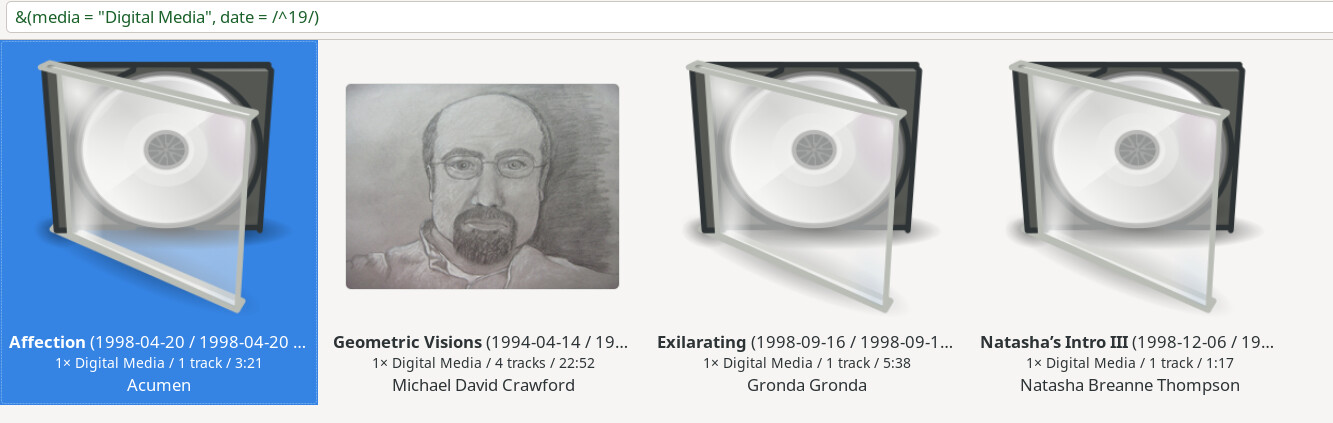
- Release “Affection” by Acumen - MusicBrainz
- Release “Geometric Visions” by Michael David Crawford - MusicBrainz
- Release “Exilarating” by Gronda Gronda - MusicBrainz
- Release “Natasha’s Intro III” by Natasha Breanne Thompson - MusicBrainz
Just because it’s niche doesn’t mean it doesn’t matter.
No idea about the big digital shops, but I wouldn’t be at all surprised if some of it made its way to Bandcamp.
3 of the 4 releases I linked to above are still available to download today, though I’m guessing on a site that none of the importers support yet.
This please. I’m fine with not automatically importing old digital media release dates, but please don’t make it hard to manually enter them.
5 Likes
The streaming sites aren’t the only source of poor release dates. Harmony can also pull inaccurate release dates from MB itself if there is a previous release with the same barcode.
1 Like
Thank you for that. I looked for artists I am familiar with in the first 10% of that list and removed dates from some.
Here are two pre-2001 digital releases from people whom I would consider big-name artists
- Release “Star Wars: Force Commander” by John Williams - MusicBrainz (see annotation).
- https://musicbrainz.org/release/66ec7b2b-12eb-44d9-85a1-28fea16de25a (see https://musicbrainz.org/edit/13328538 for a reference to 1999 availability). It is available on Spotify, Apple Music, Tidal, and Deezer.
edit: and a third Release group “tokai” by jesus2099 - MusicBrainz
1 Like
All I will point at is 18,996 found by the @jesus2099 script. And 4 found by @dseomn and a couple more by @VBZPPlNQyJ. I’ll be generous. Call it a dozen. 12/18996 = 0.0006317%
I am not saying don’t document the rare stuff. I LOVE the rare stuff. But don’t let this distort our ability to document facts. Most of the 18996 are errors. Don’t give us a default state of adding errors. Instead give us a default state of no date and allow manual edits to add correct dates.
4 Likes
I agree that importers shouldn’t blindly trust dates from streaming services.
That said, I only looked at a very small and biased subset of releases, perhaps 50 releases total. That would put the rate much closer to 1-5%. Still low, but I bet there are around a thousand with correct dates.
Edit: I suspect that there are a significant number of releases in there that have correct dates, but the wrong medium type. For example, Release “Symphonies nos. 1 · 5 · 6 · 8 · 10 · 15” by Shostakovitsch; Berliner Sinfonie-Orchester, Kurt Sanderling - MusicBrainz is listed as a digital release from 1996. Looking at the edit history, the creator links to a discogs page for a “digitally remastered” CD release. Perhaps the name of the “digital” format also needs to be clarified?
4 Likes
I understand the logic behind rejecting dates that are clearly impossible for a specific streaming service. If Apple Music did not exist in 1993, then a 1993 date shown there is very unlikely to be the release date of that specific digital version, but rather the date of the original album.
However, this is exactly where I think an important distinction should be made: a pre-launch date is certainly a red flag, but not necessarily conclusive proof that the date is wrong in every case. It may still reflect inherited catalogue metadata, an earlier digital availability through another channel, or distributor-supplied information that does not map neatly to the public launch date of the platform.
My concern is what happens next. If the solution is simply to discard such dates automatically, that may reduce false positives, but it does not necessarily improve the broader usefulness of the data.
MusicBrainz describes itself as an open music encyclopedia and as a universal lingua franca for music, intended to help both people and machines communicate meaningfully about music. From that perspective, I think it would be helpful not only to reject doubtful dates, but also to think about how to build a bridge between the historical/archival view of a release and the practical digital view used by modern platforms and downstream applications.
I am not arguing for keeping obviously wrong dates. I am only suggesting that a warning sign should not automatically become a definitive verdict, and that stricter filtering should be accompanied by a clearer model for handling these borderline cases.
2 Likes
It’s not borderline, it’s normal that an old album will get multiple re-releases.
When we don’t know a release date, we can still get the release group earliest release date. In fact it’s the most interesting date, most of the time (original release date).
4 Likes
There is a lot of interesting discussions here, but ultimately what should be the release-date for the digital editions for albums predating DSPs? Leave it empty? And remove it from the ones that’ve already been imported?
1 Like
Ideally it would be the date when it got added to the digital stores, but in most cases that’s not known / not exposed to the user.
Sometimes you can browse the artist’s social media for a promotional post along the lines of “album x now available on streaming” and that would give you an idea of when that release was distributed to digital stores, but that’s up to the artist to make that known
4 Likes
An empty date is better than a wrong date.
But, as discussed above, there are releases with correct release dates that predate DSPs.
5 Likes
I don’t know what is DSP but, if it’s the online shops from where you can get this release, then a date before it exists cannot be correct.
1 Like