Hi everyone
This is my first post here, and perhaps a somewhat belated one given that I have ~56k edits primarily on Korean indie and Japanese artists.
Over the course of these edits I had to repeatedly deal with translated/translitierated titles and saw how things were done in Japanese in comparison, where the editing conventions seem to be more established.
In this post, I would like to present two representative cases from Korean digial releases and explain why I think they should be annotated in a particular way. I would be interested to hear how others view these cases.
I will have to talk about localization, so for context I am a Korean native speaker currently based in the US. I have family in Korea, so I will be able to show how the same Spotify album is localized based on user location. This will motivate me to suggest using pseudo-release in Case 1 below (FYI, pseudo-releases are currently rare for Korean entries on MB).
===
Case 1: 노랫말 by 박재정 ( Log in - MusicBrainz ) — avaialble world-wide
- Harmony: A Song For You – Harmony
- Spotify: Spotify – Web Player
- Melon: 앨범 정보>멜론
The main question here is whether these should really be modeled as separate KR and XW releases. My inclination is that they should instead be represented as a single XW release with original Korean titles, accompanied by an English pseudo-release.
A key observation is that Spotify seems to localize the presentation of albums based on the user’s location. To editors located outside of Korea including myself this Spotify album is fully rendered in English. But to my brother in Korea, the same Spotify album is displayed in Korean:
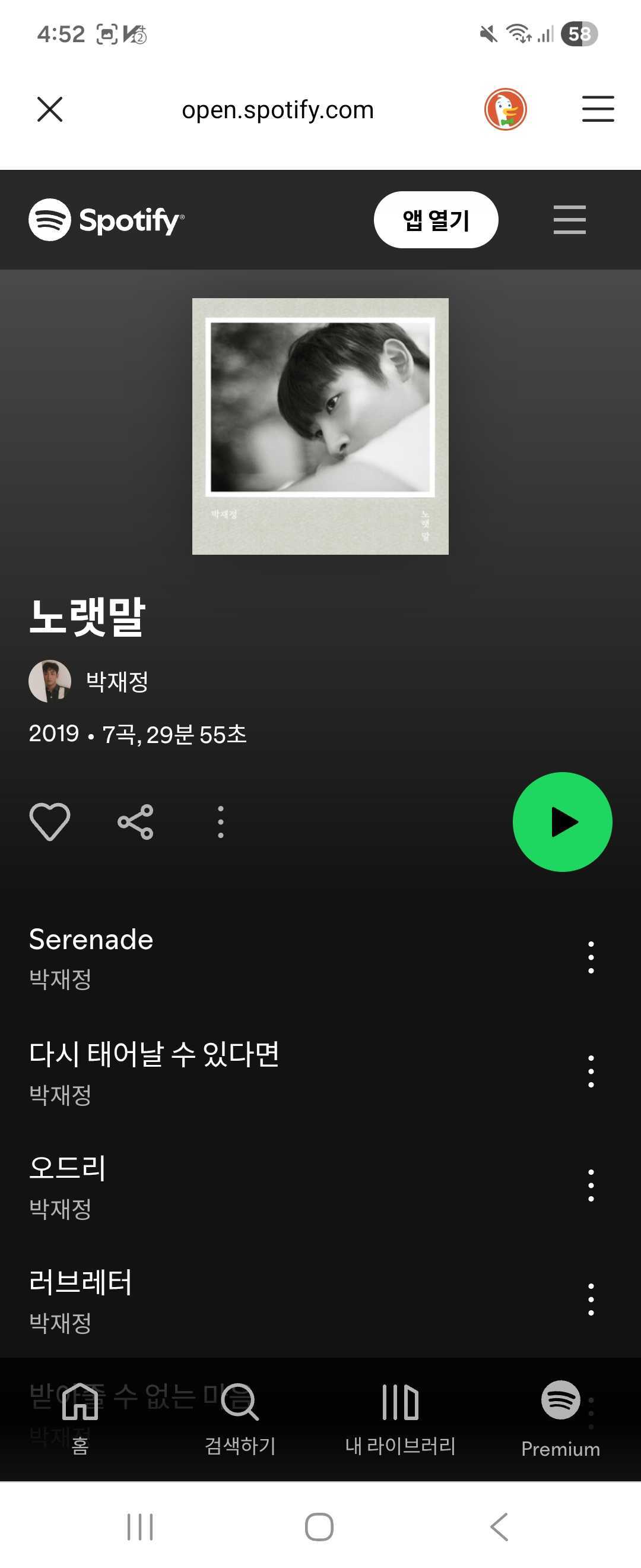
This is probably obvious to experienced editors, but to me this suggests that editors cannot automatically assume the Spotify’s (or Tidal’s, Deezer’s, etc) romanized rendering is evidence for “official” release, since they may be localized views based on user location.
To editors outside of Korea, Apple Music KR is go-to option to check for the original Korean titles: 노랫말 - 박재정의 앨범 - Apple Music
Now an added complication for Korean is that, as far as I’m aware, Korean streaming sites like Melon do not expose barcodes. There are also no catalog numbers like you’d find on OTOTOY or mora.jp urls. So there is no single metadata (other than the track-listing, which as shown above may be localized) that can be used to reliably map the Korean versions with those from global streaming sites.
These seem to be the grounds for the curent convention of having KR + XW releases side-by-side.
But if they share the same labels, track-listing, and cover art, and if we agree that the the English version is simply a result of localization, I beelive we can instead have a single XW release with original Korean titles and all of the available streaming links, along with the English pseudo-release.
In rare cases the track-listing and/or cover art may be different between Korean vs Western streaming apps, but these clearly deserve different releases.
===
Case 2: Alone 박재정 (Log in - MusicBrainz) — avaialble world-wide EXCEPT KOREA
- Harmony: Alone – Harmony
- Spotify: Spotify – Web Player
- Melon: https://www.melon.com/album/detail.htm?albumId=11227533
Interestingly the titles remain romanized to a user in Korea:
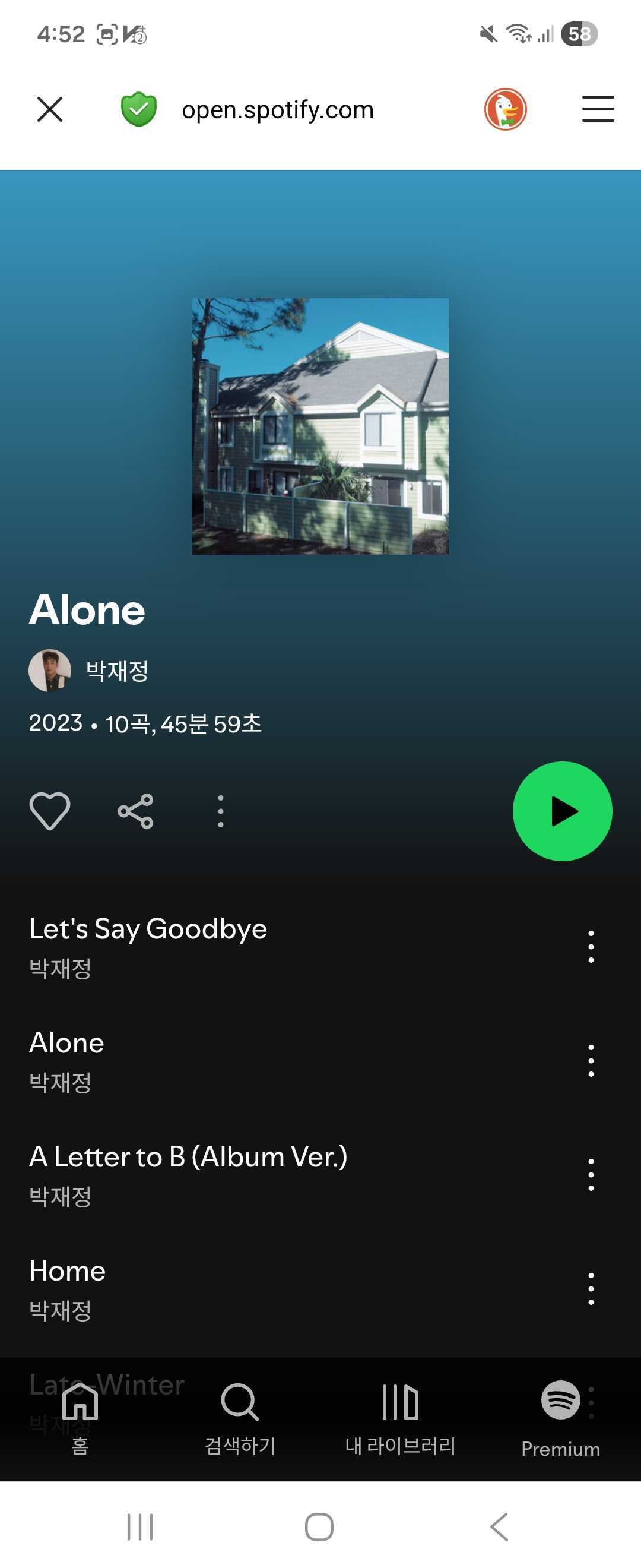
In this instace, I think the current convention of keeping KR + pseudo-XW (with annotation for “Excluded Regions” including Korea) indeed seems correct.
A similar case in Japanese: https://beta.musicbrainz.org/release-group/e5cb36b2-6e7e-4f72-ae4d-ec81b5498f4f
===
Lingering Questions
- Digital availability changes over time - Log in - MusicBrainz showed Korea excluded ( YOUNHA 1st REMAKE ALBUM 'SUB CHARACTER' – Harmony ) at the time of input, but is now available world-wide ( YOUNHA 1st REMAKE ALBUM 'SUB CHARACTER' – Harmony ). And I’m not sure which of the following should be prioritized: (1) initial release event, or (2) current availability. Given that we are talking about digital releases I’d personally lean the latter, but I wonder how others think about this
- Korean releases tend to abbreviate ETIs — for example,
(inst.)for instrumental (https://www.melon.com/album/detail.htm?albumId=13473079). My guess is that it’s a historical thing that has little to do with artist intent, but since there is no language guideline for Korean we simply import it as-is. But I think the general guidelines suggest writing it out in full. I wonder if this can be settled for consistency. - For the pseudo-XW release (everywhere except one or a few countries) the convention seems to be to leave the Country field blank and add annotations for Excluded Regions. I wonder whether this is generally preferred over simply treating such releases as XW (“effectively world-wide”) in practice.
Finally let me add that this post was about Korean releases mainly tareting the domestic Korean audience. With the Kpop idols the story might be a bit different.