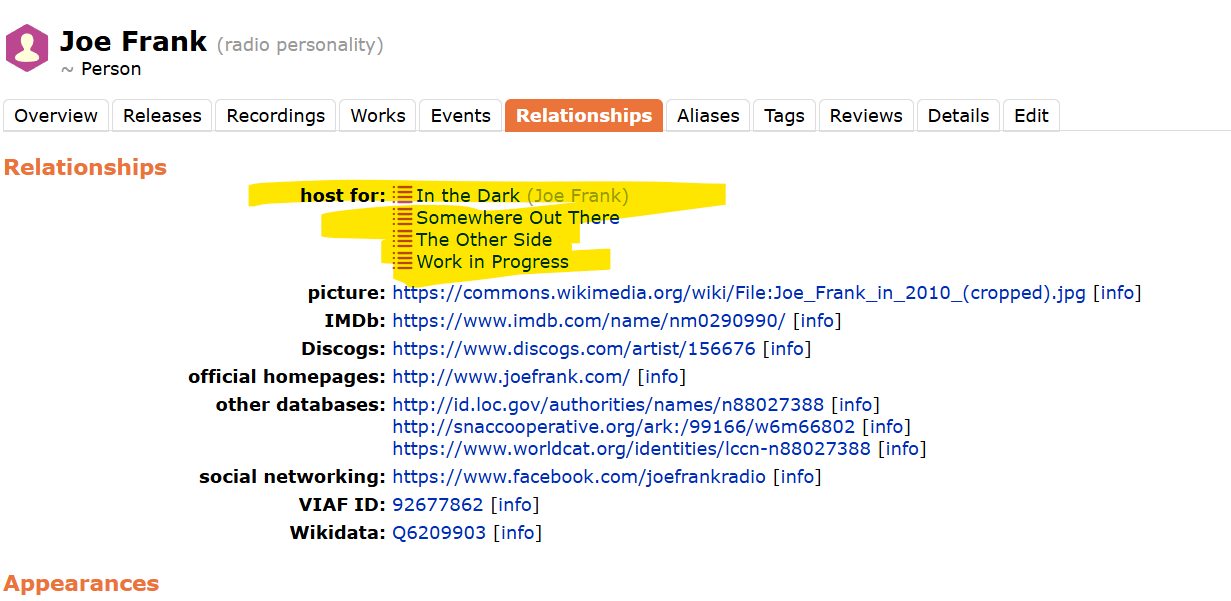
Pretty new to this so… Looking at this artist: e5d0fc8c-c2c1-4cc7-b4af-d1e35f56d0db. Notice there are “Shows” that act as a series/category that spans numerous years. Each and hour long, so a “release” in its own right. This is how the releases are currently entered as their own releases. This results in a cumbersome list with no “binning” the releases in their own category like you would with an album. Am I correct in this and that these should these be organized in a different way? If so how would I go about fixing this?
Thanks.
It makes it easier for people to help you if you put a URL to the artist: Joe Frank - MusicBrainz
I am not quite sure what you think is wrong here. I see lots of releases in release groups.
Are you saying that a number of consecutive shows would add up to connected shows? For example these three:
Or are you finding a way to group “Work in Progress” and “In the Dark”?
Then that is still correctly done as they are all stand alone shows. Maybe a series can connect them, but would not gain you much.
1 Like
…therefore there are releases, each in its separate release group (it seems, they were released separately), containing the date when first broadcast in the title (the original broadcast dates span numerous years, yes). They do not have a release date, because it’s unknown when they where first digitally released.
Unless you know otherwise don’t change anything.
To group releases and release groups, there are series - see above ^^^
Let me add something:
MB is not specifically designed for broadcasts. It’s fixed structure has a release group = album which contains a number of releases with the same or almost the same content. These are original issues in different countries, special editions, reissues, remasters,… That’s useful in most cases but not that good for the (album) discography on the main page of Joe Frank. This I can see. 
All the Joe Frank shows are well-organized / binned into release group series corresponding to the shows, for example The Other Side and In the Dark.
1 Like
Thanks for the responses. I want to be specific about what I mean, with two contrasting examples.
First, what works: Release group “1978 -1984: NPR Playhouse and WBAI” by Joe Frank - MusicBrainz — “1978-1984: NPR Playhouse and WBAI” — is a release group that appears directly on the artist page, is navigable This is also the structure that allows downstream tools consuming MusicBrainz data to build a proper folder hierarchy — Joe Frank / NPR Playhouse and WBAI / episode — rather than a flat dump of hundreds of releases. That’s the behavior I would expect across the whole discography.
Second, what doesn’t work: In the Dark - MusicBrainz — “In the Dark” — is a release group series that is not linked from the artist page at all, is only findable via direct URL, and is also incomplete (in the dark complete series list). Riwood cited this as proof that the releases are already well organized, but a series page that isn’t reachable from the artist page isn’t usable by anyone browsing the site or any tool consuming the data.
Are there any drawbacks or style guideline violations with using the “NPR Playhouse and WBAI” release group as my model for how the rest of the discography should be structured? I’m happy to do the work of organizing the data myself, but want to build out my understanding before touching anything.
Release “1978 -1984: NPR Playhouse and WBAI” by Joe Frank - MusicBrainz is a compilation, purchased as a compilation from the webstore. Look at the description on the Release.
In the Dark - MusicBrainz is how MB does things. The releases in this series are gathered together as a Release Group Series. Fairly sure Picard has this on the todo list to be able to create the type of pseudo release from that you are talking of.
A single show is a single release because this is the single entity that was released. If they then re-released that on a CD then it would join the same Release Group.
Yes. You are breaking the style guidelines as to how to organise radio shows. It would be voted down. You have selectively picked out a model that is not a radio show but a separate standalone compilation release.
1 Like