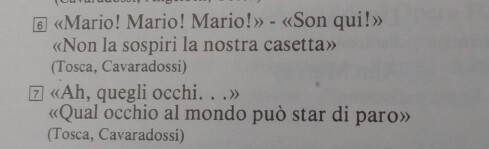
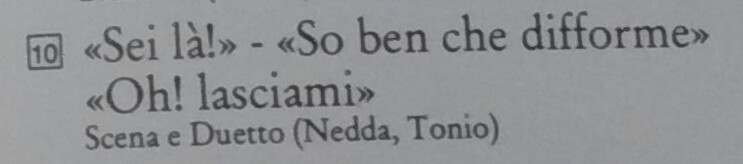
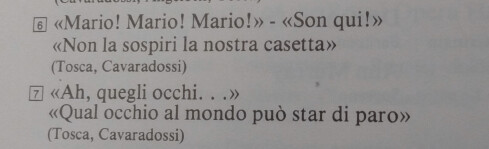
I’ve recently seen two different opera releases where the booklet used a dash[1] between quotes if they were on the same line, but no punctuation if they were on different lines. How should that be represented in track titles?
I tend to systematically use an ellipsis (…) for all these cases – standing for an omission within the text quoted from the libretto. I may use the (em-)dash, when it stands for a change of vocalists. So here, for Tosca, [Tosca] “Mario! Mario! Mario!” – [Cavaradossi] “Son qui!” … [omission, Tosca] “Non la sospiri la nostra casetta”.
In general, for punctuation, I follow our language specific guidelines, not the covers/booklets which are often wrong or inconsistent
For track titles (not recordings or works), that seems wrong to me. Unless it’s a clear error like a' instead of á, shouldn’t we follow the printed tracklist as closely as possible?
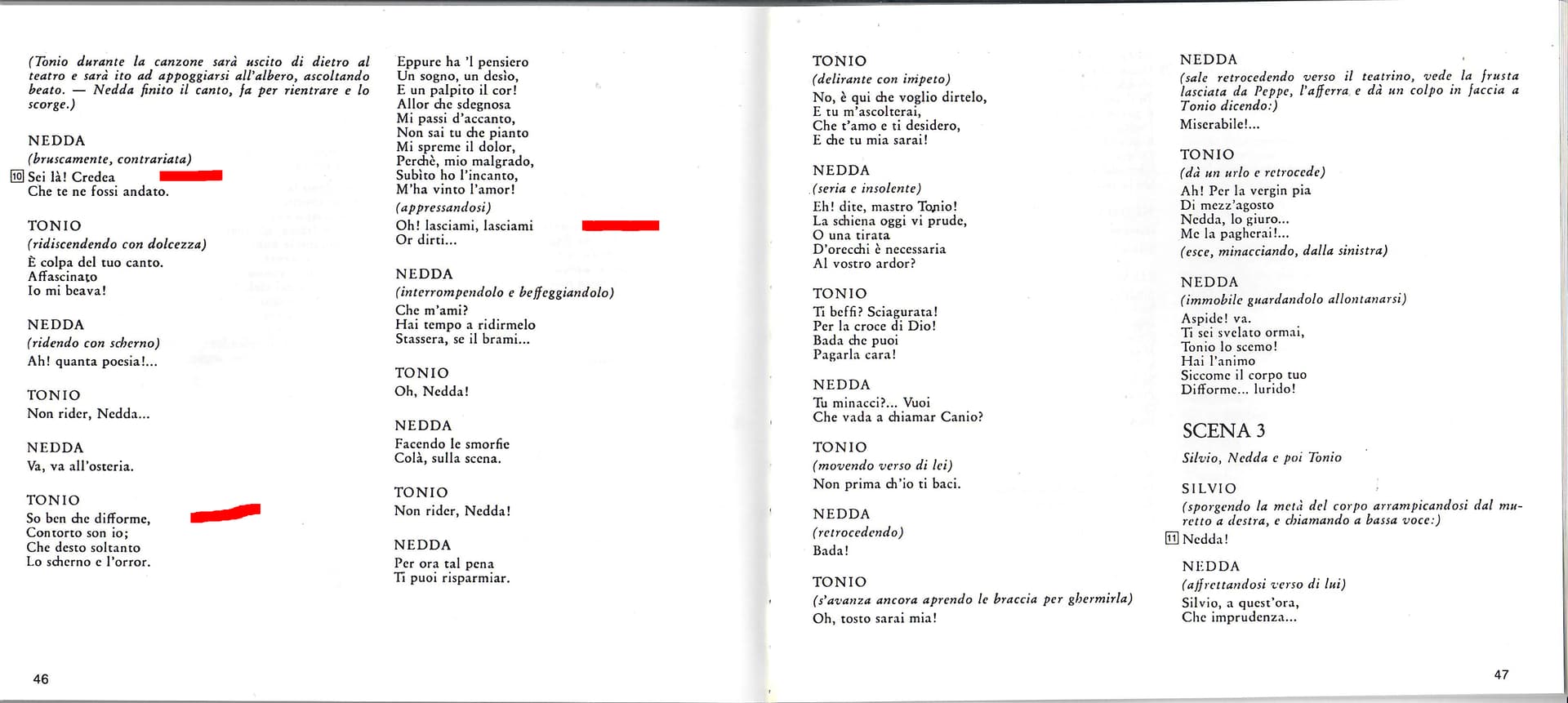
In these examples, it looks to me like the dash is joining words sung by two characters at the start of a number or scene into a composite title for that number, and the line break is indicating that the following words are the title for the next number. Thus, the booklet seems to say that this track contains two numbers or scenes of the work. A way to check this is by looking at the score or libretto for the opera, to see how those two lines actually relate.
The MusicBrainz style for joining titles of two works in one Release title is the slash, “/”, per Style/Classical/Release Title. I don’t see this mentioned in Style/Classical/Track Title, but it seems sensible to generalise the slash to Track Titles.
At a higher level, an editor entering a classical music or track title is probably trying to achieve five separate, and sometimes conflicting, goals:
Accurately record what is printed on the Release artwork, mistakes and inconsistencies included
Work within and around the technical limitations of MusicBrainz (e.g., a Track Title cannot include a line break, and cannot be multiple text strings)
Correct mistakes so that the Track Title is correctly formatted (Style/Classical/Track Title, and the per-language guideline like Style/Language/Italian, should be the references)
Have some consistency in Track Titles across MusicBrainz (again the Style guidelines should help with this)
Allow even non-expert editors who perhaps don’t know the language be successful
Trading off between these goals requires a certain amount of taste and judgment. My experience is that making a reasonable attempt resulting in a pretty good result is welcomed. Perfection is nice to have, but certainly should not be the enemy of the good.
Oh, that makes sense, thanks! I thought it was just wrapping lines to fit the width of the paper. I’ll look through the librettos to see if that’s what’s going on.
Style / Titles - MusicBrainz says to use slash when “a track includes two or more songs” too. If the newlines in those booklets are meant to separate titles rather than just for line wrapping to fit the page size, then I definitely agree about using slashes.
Also probably editors who don’t know the conventions of the type of release they’re editing. E.g., it took me a while to realize (decades ago) that opera track titles were often quotes from the sung or spoken words.
While I generally agree, I’d really prefer having more clarity in the style guides to explain (almost) all the corner cases. I think (but I’m not sure) it would make updating tags with Picard a lot easier if the changes were mostly adding missing information or fixing mistakes, rather than different interpretations of how to enter a release.
Also, getting into the history a bit, I feel like the culture around this still hasn’t fully adapted to next generation schema. Before that, it really made sense to normalize things a lot using style guides to specify punctuation and the like. Slight differences between what are now called releases in a release group could be smoothed over by that normalization, making it easier to agree on what the pre-NGS release should look like. After NGS, it seems like we should have emphasized the printed release info a lot more than we have. (Though things like newlines of course still present an issue.)
I agree with this also. Another part of the cultural lag is based on what I call “Three Strings Bias”. It is based on a mindset that what we are really doing is making a database for populating tags in music files. The only tags most people care about are Release Title, Release Artist Name, and Track Title (plus Release cover art). These only fit into music files as short, single-line text strings. So, a lot of of our culture is still trying to squeeze all information into the Three Strings, not quite relying on the more expressive structure of Relationships.
Another way (but not necessarily a better way) to look at it is that we are at least somewhat just “making a database for populating tags in music files”, but that more information should go in those tags and music players should use that information better. E.g., I wish I could have track numbers in my music players that match the actual track numbers on phonograph records or cassette tapes (A1, A2, … B1, …), and being able to click on one artist in a release artist credit to see other releases by them would be nice too.
That track is currently entered as below, without punctuation where the newline is. That seems to be the closest to what the booklet probably intended, maybe?
Pagliacci: Atto I: Scena II: «Sei là!» — «So ben che difforme» «Oh! Lasciami»: Scena e duetto (Nedda, Tonio)
“Mario…” (Tosca) and “Son qui” (Cavaradossi) are the first two lines of track 6. “Non la sospiri…” (Tosca) is a few short pages later. I don’t see any clear indication in the libretto that it was intended as a separate number, but that at least seems plausible.
“Ah, quegli occhi” (Tosca) and “Qual occhio al mondo…” (Cavaradossi) are the first two lines of track 7, which is what track 6 used a dash for.