My problem is that I’m trying to find information about bands from the past, and I often have to piece it together bit by bit. So, is there somewhere (for example, in the annotations?) where I can list all the links to my research sources—where I found the information? That way, if someone else wants to verify my information, they can use the sources I’ve already found (such as websites on the Web Archive or defunct social media sites).
3 Likes
You don’t have to cite any sources publicly; that’s what edit notes are for.
5 Likes
Wikipedia of that artist or some dedicated page/wiki that you can link to.
Annotation is for release, not groups. For groups you only have external links so that will have to do.
What @HibiscusKazeneko said is true for edits, but also feel free to use the annotation for this purpose if there are sources that are hard to find and likely to be useful for other editors as well.
Annotations exist for most entity types in the database, including artists.
10 Likes
This is such a useful thing I wish we could do. Edit notes swallow so much knowledge in noise.
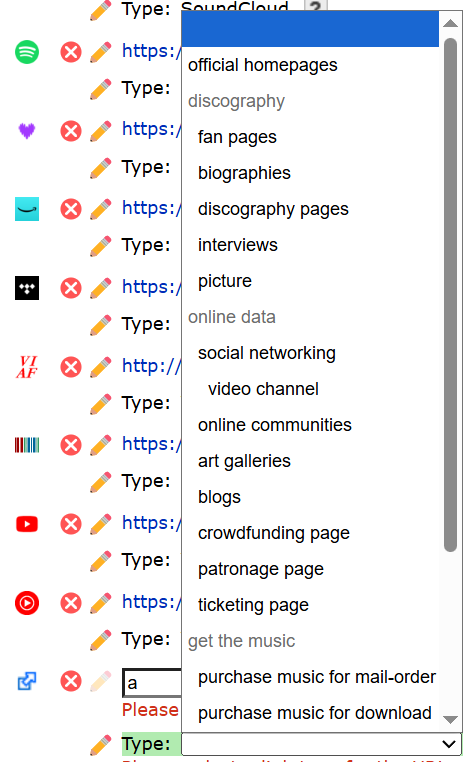
Some URLs can be added as “links” against the Artist. You can add a URL as “fan pages”, “Discography”, “interview”, “online communities” and others.
As someone who also researches obscure bands these kinds of links can be really useful.
It would be so good if there was a “discussion” page on the artists or something like this. It would make it easier to discuss with common editors who actually know about the band.
Also, as above, add notes to annotations. That way the next editor will see them and can expand on them.
5 Likes
Let me clarify. What I have in mind is something like the “References” section on Wikipedia, where there’s a separate section for such links.
Right now, all links are only in the edit history, which isn’t very convenient if you want to verify or check existing information that was added, say, 10 years ago.
I agree with IvanDobsky—it would be convenient to have something like a discussion page where you can leave links to pieces of information, and if I leave and don’t finish adding that information to the group, someone else could continue the task if they wish.
ps: I apologize for the delayed response; for some reason, it takes a very long time for my messages to be reviewed.
2 Likes
I do the same for information that will not fit anywhere else and could be “removed” from the annotation. I also keep tons of notes locally but local notes are of no use to anyone else since they cannot see them. I work mostly on bluegrass and old-time music and have added well over 3,000 artists in those fields, some have taken several years to gather the “tiny” shreds of proof of who they are and their relations because many of them have the same or close name due family relationships. COVID caused many artists to drop their web sits and that information is now gone forever unless it was archived, which in most cases it was not. To me this is about preserving history and that is why I am a MB editor.
7 Likes
But it’s great to see what reference was used to back up the very specific edit that you want to make sure of.
A reference section would not show what reference was used for what edit.
1 Like
The key is to be able to do both. Adding edit notes with references is one thing, but that is very specific to just the edit. Being able to share the best of your resources for others is useful.
Example: if someone edits “Album A” with reference to a fan made resource full of golden info, then those URLs are lost under Album A’s edits. When I go and edit “Album B” then I have no idea about this golden resource that was used to fill in Album A’s details.
Good examples are fan made discographies listing concerts. An artist will perform thousands of concerts and it is nice to know of a single resource that lists all of these.
I have some odd resources sitting in bookmarks on my PC that have supplied all kinds of knowledge to me. But no way to share these with other people.
2 Likes
I would put that stuff into the annotation - does it really get removed from there?
I’m not saying it’s unlikely (we MB editors are a special bunch), I just haven’t had it happen! Or I didn’t notice…
1 Like
This can be added as URL relationship, to artist, release group, or release.
Or annotation.
And if it gets deleted, annotation also have edit history to restore it.
I understand that this makes the most sense.
But what if there’s a lot of information scattered in small pieces?
For example, I have over 50 links to various archived websites, fan groups, etc. I think this will cause the URL relationships to become overloaded, and after that, it will be impossible to tell exactly where each piece of information came from—unless you open the edit history (which might have a lot of edits and require further searching) and the person also leaves a link to the specific source where they got the information.
Also, pages are sometimes misidentified. For example, by marking all links to Vkontakte as official, which may be incorrect, or sometimes by refusing to post a link at all if it’s in an atypical format.
I understand that my request is unlikely to be implemented, but I just want to make sure whether or not this functionality exists. If not, I’ll simply do everything locally and document only what’s necessary in the database.
2 Likes
I guess the proper solution is for MB to have its own artist wiki. This is complex info that isn’t suited well for 1 annotation page with extremely limited formatting capabilities. Also, target group (MB editors) is specific.
Maybe that can even solve an issue of artist images.
1 Like
Well yes it exists, as annotation and edit notes.
You are welcome to paste your stuff in there.
But please use URL relationships instead, each time it’s possible, even if it makes many many URL (for many different websites).
2 Likes
I guess I still don’t really understand the problem - why not put your information in the annotation, tidily? Has anyone said not to? As long as the most important information is up top, I don’t think the length matters, and there isn’t a length limit as far as I know.
5 Likes
The problem is that 1 wall of text page is not appropriate for serious research that is to be stored only on MB and not externally.