I have a question about a CD and digital release that share title and (mostly) tracklist.
The Release group “Selected 1987-2017” by ANÚNA - MusicBrainz currently only has a Digital Media release added to it. I own both the digital release (.flac files with pdf liner) as well as a physical CD copy of this. The filenames of the .flac files have suffixes like ‘(live)’, ‘(2017)’, and ‘(Remix 2017)’ added to some but not all tracks. These suffixes do not appear in the tracklist, neither on the back of the CD Digipak, nor on in the PDF liner notes.
Audibly, the tracks seem identical between the two, but the acoustid’s generated by Picard from the flac files and from the Apple Music generated ALAC m4a’s don’t fully match. Also, there is some slight variation in the track length reported on the flacs and on the CD TOC.
Should I assume that both releases were created from the same recordings and link the recordings up with both releases, or am I not allowed to assume that and should I create separate sets of recordings?
Also, on the packaging, there is a ‘|’ (pipe-symbol) between ‘Selected’ and ‘1987 - 2017’, would you suggest “Selected | 1987 - 2017” as the Release (Group) title, or “Selected: 1987-2017”.
Note that there is also a CD titled “Selected II | 1987 - 2017”, which is weirdly listed as Release group “ANÚNA Selected II” by ANÚNA - MusicBrainz also with just the Digital Media release attached to it. For this one I also own both the digital release and the physical CD. Here the release on MusicBrainz has one track title that has ‘(2019)’ suffix not present on the tracklist of neither the physical copy nor the flac-files in the digital copy I have. My physical and digital copy were purchased in November 2017, but currently Bandcamp lists this release as being from May 7, 2021; which would also explain why there would be a ‘(2019)’ version of a track on it, my digital copy can therefore not have the same recording. Like the first ‘Selected’, the flac files I have also have several of them with ‘(2017 Remix)’ or ‘(2017 version)’ in the filename.
Hello, I don’t know this artist or your MB editing experience, but here’s my two cents.
A new mix requires a new recording, but a new mastering does not. If you suspect the stems were re-mixed, you should create new recordings. If the AcoustIDs do not match and you’re unsure if it’s the same recording, you should create new recordings. Only merge or re-use recordings when you are 95%+ sure it is the same recording based on good evidence or listening directly. You can also visually inspect the AcoustID fingerprints, though this isn’t foolproof either.
Extra title information (ETI) like ‘live’, ‘remix’, and ‘remix 2017’ usually indicates these would differ from the recordings on the physical release. It’s not impossible however that the designers simply chose to exclude this information from the physical release. If this artist is popular enough, perhaps some forum discussion elsewhere has already questioned whether the mixes on the digital and physical albums vary (e.g. on Reddit or a fan site).
It’s useful to include research info like this in the release annotation, especially if you choose to keep the recordings separate, because another editor may come along later and wonder the same thing (if they are the same, if they should be merged).
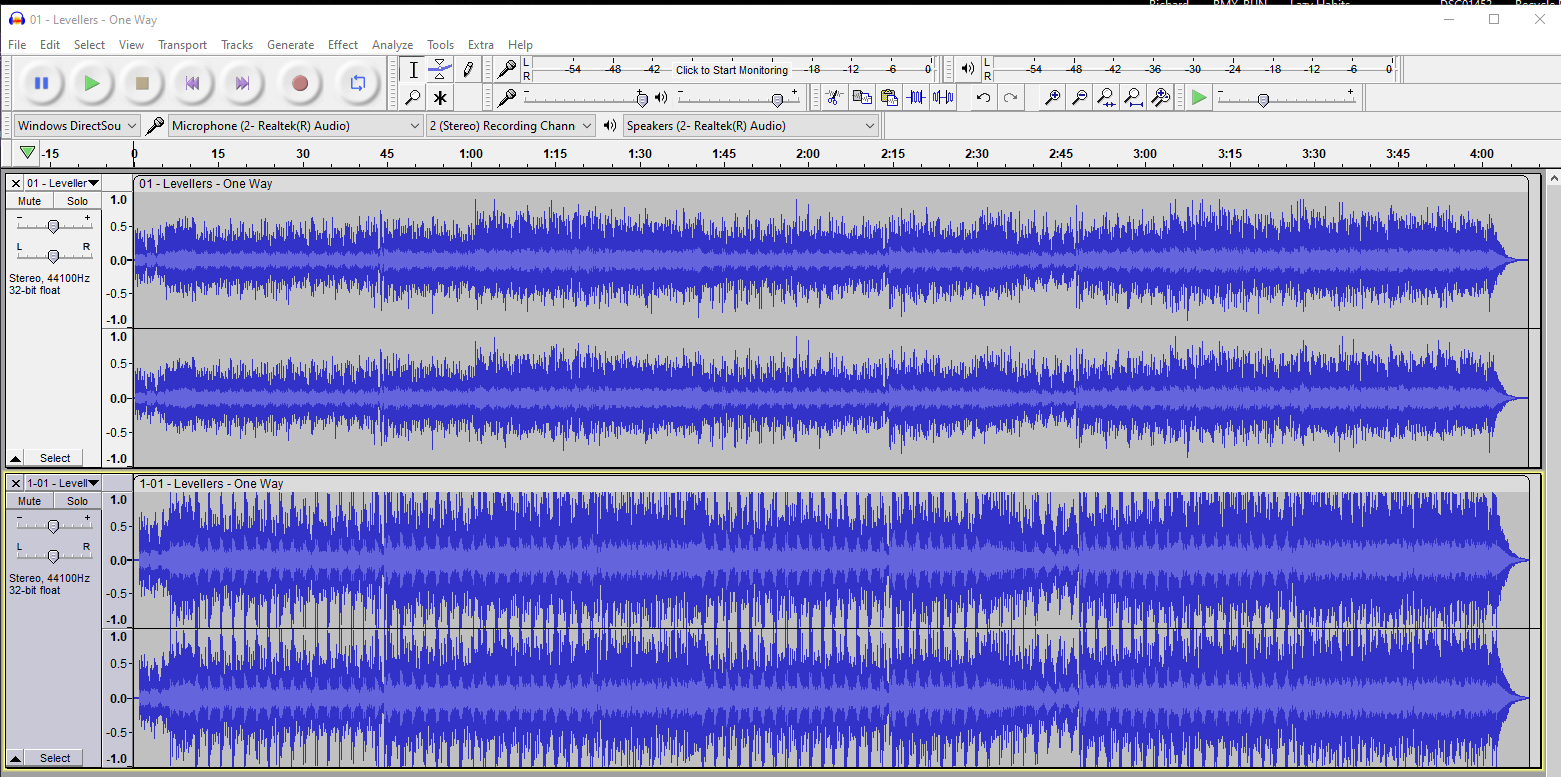
When trying to spot new recordings I will load up Audacity and visibly compare the two tracks. Sometimes you find a newer release has been “remastered” and made louder. This leads to new AcoustIDs, but the same audio.
You can see this in the wave pattern on the screen as something remastered louder has the same spiky pattern of peaks and troughs, but will be taller in the image. Audacity also lets you play both versions at the same and quickly flip between each of them with the “solo” buttons to see if anything else has been inserted.
Personally I wouldn’t consider a change of volume as automatically indicating a remix. This could simply be a consequence of the ripper or because replaygain was run against it.
A different accoustid is IMO more indicative of a remix, though I don’t know enough about the acoustid algorithm to know how good it is at avoiding both false positive differences and false negative differences.
Whilst I agree with the theoretical basis of @agatzk’s answer, I do think that you need to differentiate between a genuine remix (e.g. a DJ remix or a remix for the 50th anniversary re-issue album i.e. a deliberate artist / producer intent) and e.g. a very minor remix by a junior engineer when creating a digital release from the same master tapes used for the CD version simply because e.g. differences between technologies would otherwise make them sound slightly different (or because they tried to make them sound identical but they ended up slightly different etc.).
In addition there is a practical difficulty because:
In practice multiple Musicbrainz recordings of the same actual recordings (without remixes) are extremely common, both due to historical workflows when creating alternative releases and also because less experienced users don’t use workflows that will now avoid such duplications.
Well intentioned users often then try to merge recordings which appear to be identical; and
It may become impossible to distinguish between multiple recordings genuinely created because different accoustids indicate some sort of very minor remix and multiple MB recordings which are really duplicates when they probably shouldn’t be.
Consequently unless there is actual evidence of an artist / producer intent to remix, then in the circumstances described here I would probably vote to reuse the same existing recordings and add the alternative accoustids to the same recordings. (Would it be easy at a later date when more evidence of a deliberate remix emerge to split a single recording with say 2 accoustids into two separate recordings each with a single accoustid, or easier to identify multiple recordings at a later date which turn out not to be a significant remix and then merge them.
Just my tuppence-worth, but I would readily admit that this is a subjective view that may be in a small minority - and so will readily defer to more knowledgeable views from more experienced editors than I.