Moving compilations to another artist

Is it OK if I move these uncredited compilations to the artist

fc8b6db8-695c-4faf-a9f6-3d9051eab587 (as “Star Inc.”)

They actually contain recordings by the various groups produced by or aliases performed under by this artist. They are currently credited to songwriters or [unknown] by another submitter. There are 5 CD and one of the CDs has been submitted individually. Peter Weekers is only the soloist on CD1. It is a reissue of this album 5c66d9e2-fb8f-428a-a4df-3499ea768b69 . CD3 is mostly by The Broadway Stage Orchestra. Other compilations of these recordings already exist under Star Inc. and are collectively credited to London Starlight Orchestra or Star Inc.

2 Likes

A warning… heading into anything Star Inc related will damaged your sanity. This guy released and re-released his same old synth recordings hundreds of times under so many different aliases it will make your head spin trying to make sense of it.

Following the AcoustID will often take you towards the original recordings… but it is such a tangled mess that it is almost impossible to untangle.

Personally I see no reason any of that CD should be credited to CSG style and should all be Peter Weekers… and instead link the works to get the composer credits

4 Likes

I see what you mean. Andromeda Project, Allen Toussant Orchestra, London Studio Orchestra. These were often names used on other budget labels, but might not always be Starink.

There is no Classical Music here. He has a few releases of classical in modern arrangement, but that is a topic for another day. Rather I’m asking if it is fine to apply the artist Star Inc. as an umbrella term for these releases instead of what they have now, and to retag individual tracks more specifically. They would be better placed in Star Inc. discography rather than Various Artists/[unknown].

Peter Weekers only emerged as a name on some recordings. It is clear which ones those are by the sound of the pan flute over the otherwise identical mix. The other discs do not have Weekers on them, which is why I think they need to be changed. The covers do not mention any artist. Of course the tracks are not perfomed by David A. Stewart or other authors as is written now.

I can identify the recordings by listening and comparing them to the primary releases. CD1 is a complete album, and I have CD4 on me.

They are always Starink. I got lost down that rabbit hole once. Ed Starink knows how to squeeze every cent out of his old recordings. Repackaged so many times and release under those alternate identities. Often pretending to be an orchestra when it just just one man and a synth.

It is impossible to work out which name he used when he first recorded these tracks. I tried, then gave up. Don’t rename them to just “star inc” as that is his company. Just rename them to the earliest recordings you find. The more we try, the closer we get to the truth. Impossible to know for certain.

He is not the only synth artist doing this…

3 Likes

He did print on some covers “Played by Star Inc.” or “Sythesized by Star Inc.” as a name. That seems like a fitting album artist. Track artists should be London Starlight Orchestra, The Broadway Stage Orchestra, Peter Weekers, or Ed Starink. The vast majority of his recordings have appeared under “The London Starlight Orchestra”, which is the main name used for pop music, even when otherwise credited to Alex Bollard [Assembly], Peter Weekers, Bob Kaper or Robert Janssen.

The names seem to follow the album theme with the same set or performers: French music (L’Orchestra du Soleil), Christmas music (Canterbury Chorale).

Vocalists can be The Mike Sceptre Singers intead of The London Starlight Orchestra & Singers. Or just under the name LSO.

I added a few new identities recently:

Philippe L’Auran (known to be himself), L’Orchestra du Soleil, Antoinette Ventura (I suspect this was inspired by Anthony Ventura but have no proof), Samantha Blue (I suspect it is a false name).

I really like this music and it is worth organizing.

https://imgur.com/a/M4mWd9c

I have not explored the lesser known names. It is possible that not everything under those labels is himself, but could be other orchestras.

1 Like

I disagree that the majority appeared under “The London Starlight Orchestra” as he spreads his name far wider than that. Worst part of that name is it overlaps with other artists who use a very similar name.

Different eras he uses different brandings. And then also sells his music to other labels to rebrand. It is a hellish mess. But at the core it is Ed on a Synth. No matter how he is trying to represent it.

I notice you mention a lot of names I didn’t seen when I was working his output a few years back.

All I can advise is to stick to MB guidelines and don’t guess or assume names. And AcoustIDs are really really handy here to prove a link between recordings.

And then there is the headache when he re-recorded some tracks. Can we really tell when he did a new “recording” of the same old preset on a synth…

Go careful when merging recordings as once merged it is impossible to unmerge. And be aware that the buggy way that AcoustID works means there is a huge delay (of years) before AcoustIDs of merged recordings are truely merged.

My personal opinion is no “orchestra” should be credited for any recording. The true name here is Ed Starlink and his synth. Yeah, the “orchestra” could be in a track list, but not the actual recording. This is a synth, not a real orchestra.

Other people have been here along with me. @sound.and.vision is another person I believe has been on this painful journey too.

I also warn… once you head into this rabbit hole you will also meet up with Russel B. Another seller of syth tunes like Ed Starlink… who also uses that Starlight Orchestra name.

My best advice is run away now…

1 Like

You should really listen to the originals.
Ed Starink stuff is just cheap synth cover albums to make big money thanks to composers’ famous names printed in big on his packagings.

People are tricked by this Dutch guy.
They thought they bought the original Vangelis, Morroder and J.-M.Jarre tunes, but they got some unimpressive synth covers.
I’m one of them, when I was a child, I was so disappointed. :sob:

It’s not even covered with new personality.
We don’t need these imitations. :wink:

2 Likes

Then unfortunately I can do nothing. Because “by the book” it is Various Artists and [unknown] because each of these groups counts as an artist and they are not printed. One can submit inaccurate information, and then every correction has to be argued. I managed to get most of the discography into Rate Your Music, but I can’t go a back and change Release Type when the chronology of recordings had become clear in a completed set.

These two releases really should be moved. May I do it or not?

The Russell B discography looks compact. Good job separating the other aliases. The output on other labels is best ignored. With many artists you get a primary discography and endless compilations that can implode the hard drive of a dedicated fan. I listened to Russell B. on Elap Music (primary releases) and think it is of low quality.

My collection is about 40 GB. I can sort the tracks by name and compare easily.

1 Like

This is one of the reasons it also drove me to confusion. I wanted to name recordings like this as “Ed Starink”, but then it became clear that some of the music on his releases really is of unknown origin. It is not always clear if it is him or not - but it is clear it is not the original composers he writes on his track lists.

This is one of the reasons I focused on the AcoustIDs a lot of the time. These could often lead me back to some releases with better credits. Usually the same album would appear with tracks shuffled into a new order.

40GB of Starink?

I agree that we need to do something with this stuff. I found it first via some Vangelis releases that clearly were not Vangelis… and then I kept digging. And it got messy.

This is the confusion that needs highlighting in some form. And documenting correctly. Recordings like this should not be appearing under Vangelis, etc as if they were recorded by those artists. It is likely pretty safe to assume a lot of the music under the Star Inc label is him… but I could only guess and this is not good enough for MB. Hence many recordings get credited to [unknown] instead.

Edit: Just had a look back at some of the work I did with Ed’s recordings before. I notice that there was a fair few credited to Ed Starink with an alias of Star Inc. I think I just followed a theme I spotted of previous editors attempts to clean up the mess.

1 Like

Darn… being sucked into the mess again :rofl:

I looked at this one:

And that is a good example of how this mess gets bad. Track 9’s cover of Groovy Kind of Love had been merged into the real Phil Collins recording. This kind of thing happens when editors are doing them big merges of tracks based on a length.

Problem is once that happens, now all of Ed’s performances are mixed into the real Phil Collins Recording.

What is even more confusing on these “Peter Weekers” CDs is Weekers is a real person, who plays pan pipes, but these CDs seem to mostly be Ed Starink stuff without Peter. A confusion of a mess…

Disconnected it now and changed it to a new recording… also found the AcoustID Track "0e9485bd-291b-4dc1-a874-015f91b4d573" | AcoustID which shows some credit to Ed’s London Starlight “Orchestra”.

The five disc set is a mess too. Can’t see how it has been credited to Weekers if so many of the tracks are just normal synth. Notice in the edit history there are other people who attempted to track its origin down and spotted this: https://www.discogs.com/release/30544711-Various-Golden-Ballads-Feelings which credits Weekers and London Starlight Orchestra.

And there is the full set: https://www.discogs.com/label/724294-Golden-Ballads-2

1 Like

I’ll also add… just saw how much work you have done in here… all looks good to me. Looks like you are already a long way down the rabbit hole. :zany_face: Albums like this 5 CD box are hell to fix. Some of my replies above are after a long day at work. Today, looking deeper at your current edits and my older 2023 edits, you are on the same track as I was. Attempting to fit a common theme to get recordings gathered under.

Star Inc was an alias I often used for Ed when I found it. Though I tried to pull things more towards his name or Star Inc as the actual recording credit where possible. Especially as the bogus “orchestra” name used as London Starlight is a confused mish-mash of other labels who use it as well.

With respect to some of his other aliases, have you read this?

Ed Starink is also known as:

Eduward Starink (real name)
Edgar Starink (as a member of the band “Gamma”)
Eddy Starr [Orchestra]
Star Inc.
London Starlight Orchestra
Philippe L’Auran
London Studio Orchestra
Hollywood Studio Orchestra
Broadway Stage Orchestra
A Close Call

That helpfully confirms that the “orchestra” is not a group. It is a person and his synth.

Found more of the old rabbit hole I was in. When editing Golden Ballards before I had star_inc appear who edits the above website and confirm this whole release is Ed Starink.

I’ll see if I can find the old emails… but that was a direct expert on the subject. (Found the emails - @cinimod you have mail from me…)

Note @star_inc’s edit history: Log in - MusicBrainz

1 Like

Thank you for the e-mail.

Yes, 40 GB. Star Inc. productions - Pastebin.com

The “Orchestra” is the collective or “Assembly” of multiple performers. Someone clearly plays a guitar on some of the tracks, someone plays sax, someone sings. Electric Light Orchestra is allowed to be called an orchestra after all.

Listening is needed. There are two recordings of Copacabana that are different compositions but similar length.

Until proven otherwise, Peter Weekers is to be assumed to be another person. Starink only admitted to being Philippe L’Auran after learning to play the piano. I have no knowledge of him playing anything but a keyboard.

Since the release of the Philippe L’Auran tracks, those recordings may sometimes appear credited to just LSO while other recordings of the same works also exist under LSO.

I will reassign the recordings on the compilation later. What is the “relationship” to indicate that an album in its entirety is part of a boxed set of those 5 CD?

I can confirm that tracks 8 through 10 here are correctly identified through some magic. The rest are unrelated. But the album artist should be The London Studio Orchestra. This would Allen Toussant name out of the list. These compilations are a dime a dozen and uninteresting.

https://musicbrainz.org/release/0ab0bbdd-380f-46b7-8796-9aa3881dac34

What is this AcoustID that keeps getting mentioned? How does one make use of AcoustID?

2 Likes

This is the audio fingerprint of a recording. ( AcoustID - MusicBrainz ) If you feed a CD into Picard, you can use the “generate fingerprint” button to make an AcoustID. This is what the audio sounds like in maths. It gives us a unique number we can compare.

If you have matched your album up and checked it, then using Picard’s “Submit AcoustID” button will now apply your new AcoustID to a recording in the database. This is important not to do in bulk and needs to be manually checked. Don’t just drop the 40GB of music into Picard and hope it gets correct matches, as it won’t. But once a release is checked as being the correct one, submitting the AcoustID is useful.

From this it is easier to spot the overlap of reuse of tracks. When a compilation takes a track from another release and reuses it the AcoustID will be the same as it is the same recording. This is seen a lot within Star Inc and the constant reissuing of the same recordings on new compilations. From your 40GB stash of CDs you’ll soon be able to confirm this for yourself.

Don’t 100% trust AcoustID matches found online. Sometimes the data online is incorrect due to bad submissions. Better to check how many samples have been submitted.

From your collection you’ll see plenty of examples of re-used tracks. This will help you see how an AcoustID can point these out to you as you can also play them by ear (or look at them in Audacity) and confirm what AcoustID is doing.
-=-=-

He makes it clear on the website that the “performers” are usually just him on his synth. There is no one on a guitar or sax, it is Ed and his samples fed through the electronics. Sometimes he’ll get in someone like Peter Weekers on a pan flute. Or pay for some vocals.

Partially agree there. But the Ed alias, not the one currently linked.

At Release Group level, you will find a Release Group relationships of “Included in” which lets you show that one lone release is also part of a different boxset.

I see you have found one of many reissues albums that are likely nothing to do with Ed. I assume this is some of the results of Ed’s licencing deals with his music. This gets messy as often artists names can be changed by the reissuing market.

Not sure what you mean. On the release you link, the credits for Allen Toussant Orchestra come from the CD credits. Rear covers are still important source for MB. (Not sure how this release connected to the boxset above?)

I expect this is an example where AcoustID would help guide you to spotting the reuse of recordings. Check the AcoustIDs of the Allen Toussant recordings and you’ll find this release: Release “The Sound of Movies (20 Great Themes)” by The Allen Toussaint Orchestra - MusicBrainz using the same recordings

Hope I have covered some of your points here. I don’t really want to be dragged into the Star Inc chaos again, but will assist in showing how the MB database is really useful for spotting the connections. Ed’s multiple identities and reuse of recordings is interesting to document.

1 Like

I’m digging again and now remember another reason I ran away :rofl: :zany_face:

There are multiple “The London Studio Orchestra”"The Studio London Orchestra". There is a legit one, and then there are one’s Ed performs as.
https://www.discogs.com/artist/341299-The-London-Studio-Orchestra
https://www.discogs.com/artist/2214432-The-Studio-London-Orchestra

Your release in the above post is likely one of Ed’s aliases. Especially as so many recordings also seem to appear on his other releases using other aliases of his.

Trying to sort out that release may be a mistake. Nailing down the actual original recordings will be tricky to get the credit right. If I was you I’d go and learn some experience with AcoustIDs on the albums in your 40GB collection first. Where you can directly listen and compare by ear to learn how useful AcoustID can be to help spot the duplicates.

1 Like

When editing “Golden Ballads,” should I better set the correct recordings by editing the release (a), or merge the ones that currently are there (b)? I am worried about leaving orphaned recordings in case A or carrying wrong data over when merging in case B.

On the compilation “The Love Themes” the front covers says “The London Studio Orchestra Presents:”, and on the back cover only tracks 16 to 19 are linked to the Allen Toussant Orchestra. There is a masculine ordinal indicator (degree, asterisk) in superscript that only applies to these 4 tracks. So the rest should be assigned to the pseudo-artist The London Studio Orchestra, minus 8-10 that have been identified.

AcoustID works. Seems too fast, only taking a couple seconds per track. I found a partial match. Not planning to do anything there for now.

https://musicbrainz.org/release/24705559-e77c-40cb-9d7e-7243e5e1d3cd

https://musicbrainz.org/release/d8ce245f-c746-47ab-b406-94890b92e9ea

If the AcoustIDs match, and even better if I can do a “by ear” or “By Audacity” match, then I’d merge the recordings that I can merge. Recording artist then traditionally goes to the “first” name who recorded it. Or with something like Ed the most common artist may also be okay as they all tend to lead back to Ed.

Generally it is safer to trust releases on the actual Star Inc label. Some of the reissues like “The Love Themes” tend to get a bit slack with who the actual artist is and I have seen made up credits.

In this case as so many of the tracks can be linked to Ed, then I would credit to Ed Starink with an alias of “The London Studio Orchestra”. With 16 to 19 linked to Allen Toussant Orchestra.

Now I see. Yes, these look like common Releases. Should be the same Release Group. Recordings merged. And even the artists merged to remove “The Canterbury Chorale and Strings” and keep the name as per the artist’s home page.

Ah - I see this is Star Inc label. Why do I now instantly question if this is the real Canterbury Choir, or the US one, or a completely different one all together? :grin:

1 Like

It is a really handy system. Compares only first two minutes, but also takes length into consideration. Pretty reliable when assigned correctly.

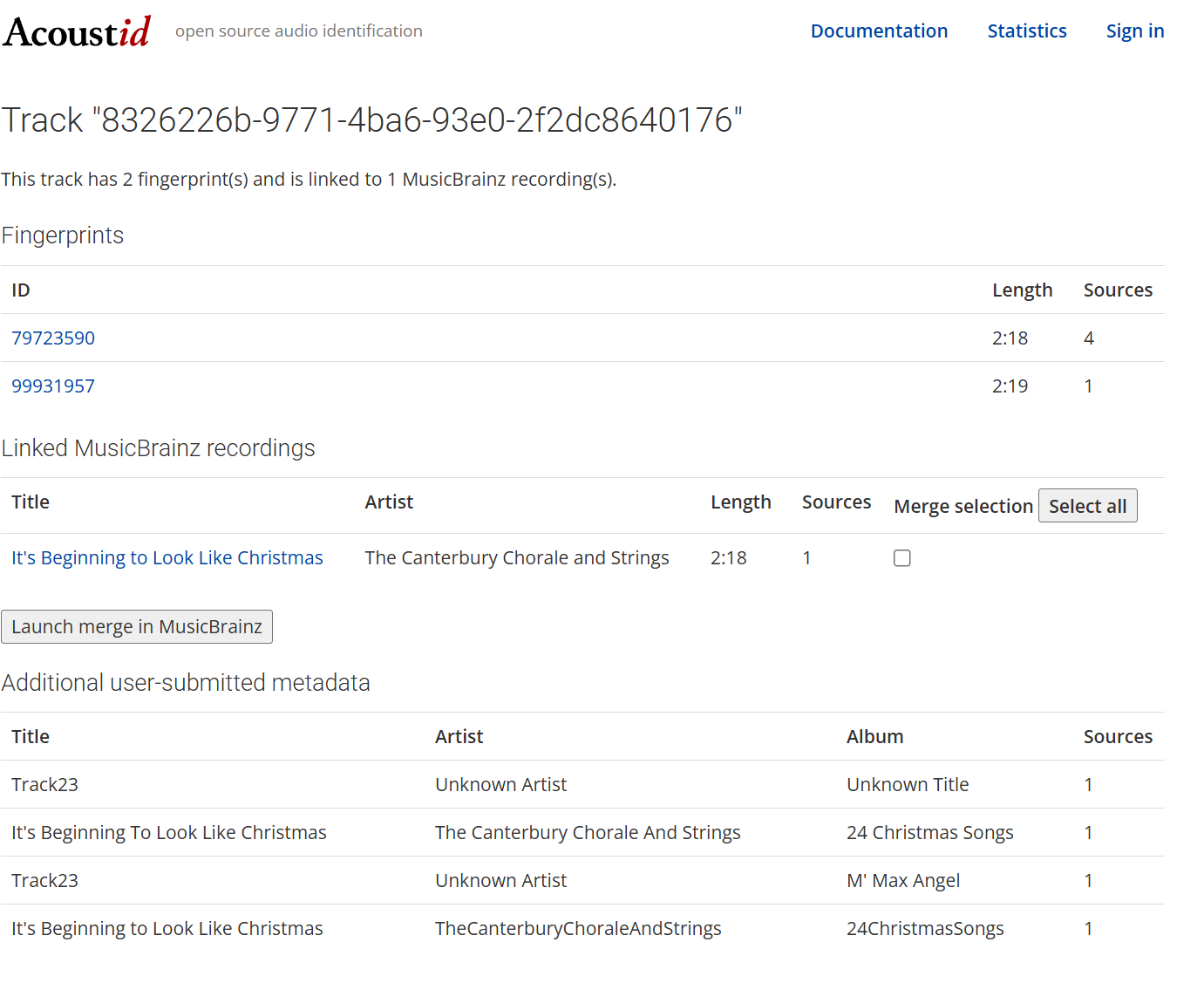
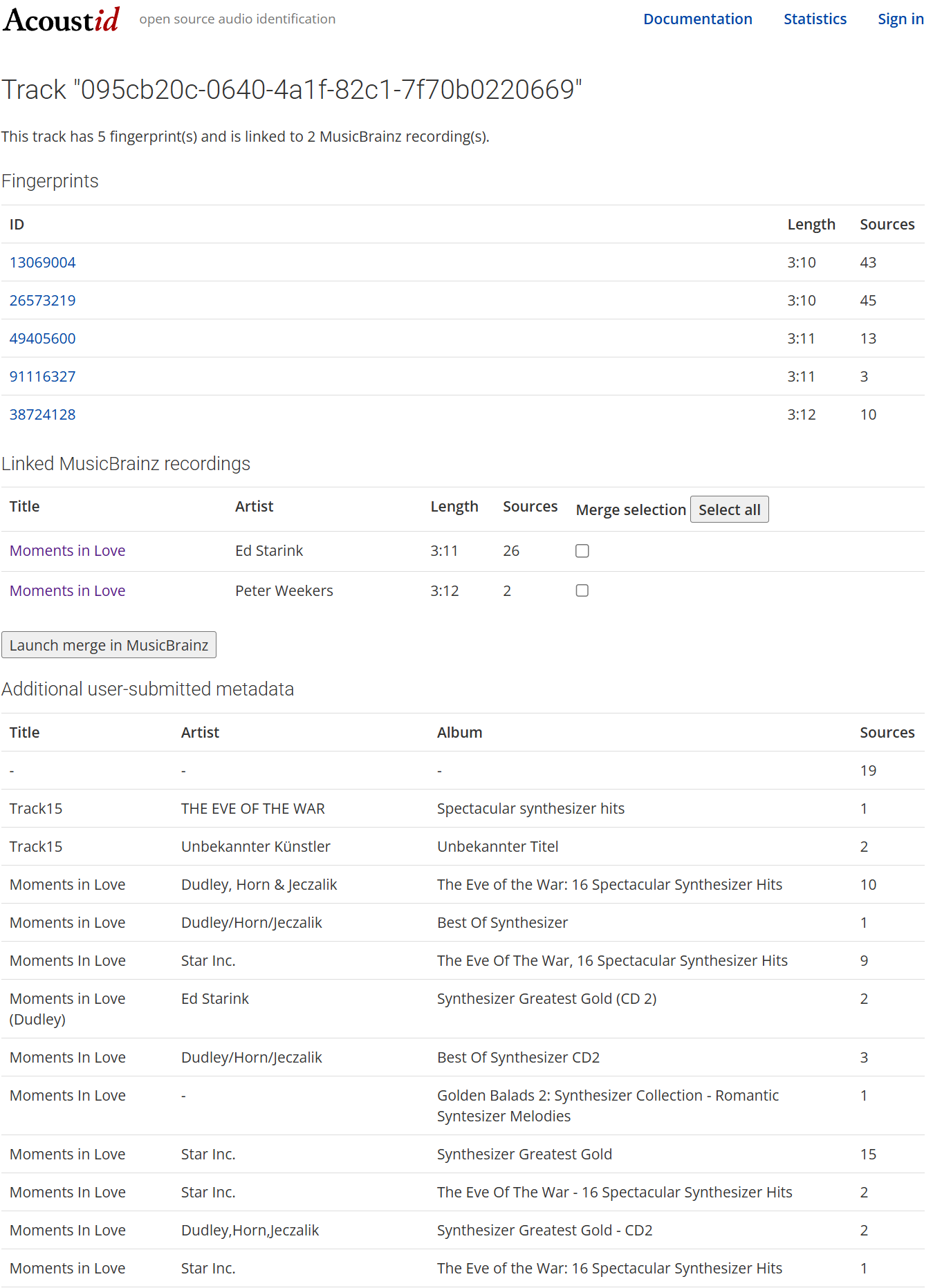
To explain this page…

Fingerprints is what you actually submit. To the right is the count of “sources”. How many are submitted.

Middle bit “Linked Musicbrainz recordings” shows linked recordings, and how many people submitted them. That “sources 1” means we can be a little wary here as only one person submitted this.

At the bottom “Additional user-submitted metadata” is from programs that are not Picard. A handy confirmation that you are looking at a legit match.


This is a really good hint that the second CD recordings appear elsewhere… 26 submissions for other Ed Starink releases that feature this recording.

This is what can suck you in a bit deep. The more you look at tracks on that release, the more you are likely to see a common set of other releases that they are sourced from. This can help reinforce the likely case that they were lifted from that other release to make this new compilation.


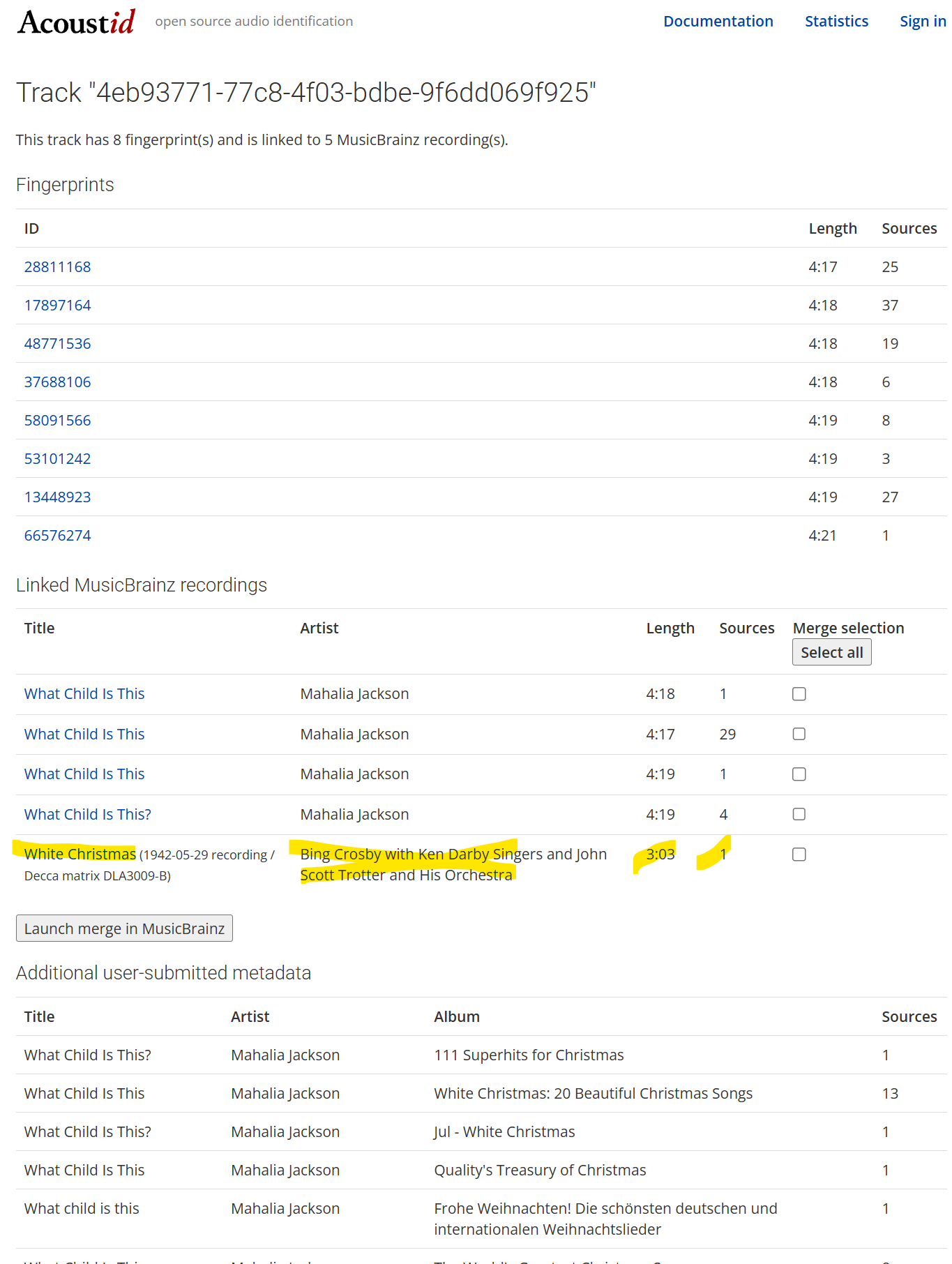
When looking at an AcoustID page sometimes you will spot errors. Use the number of sources as a cross check. Sometimes a Picard user has not checked their matches and submitted bad data. But in this multi-pseudonym world it can be more confusing. So if you see a recording of a different name in the list, but with a very low number of sources, then it is likely a bad submission.

In the above image we see a track with one same, wrong title and artist, and nothing else that looks like it in the “additional” metadata section. Clearly an error that can be ignored\disabled.

Alternately, with Ed, you can find five recordings linked all named the same, but each credited to a different artist. And a closer check you can then find all of those artists are pseudonyms of Ed. Working on Ed’s many links can get confusing :rofl:

1 Like