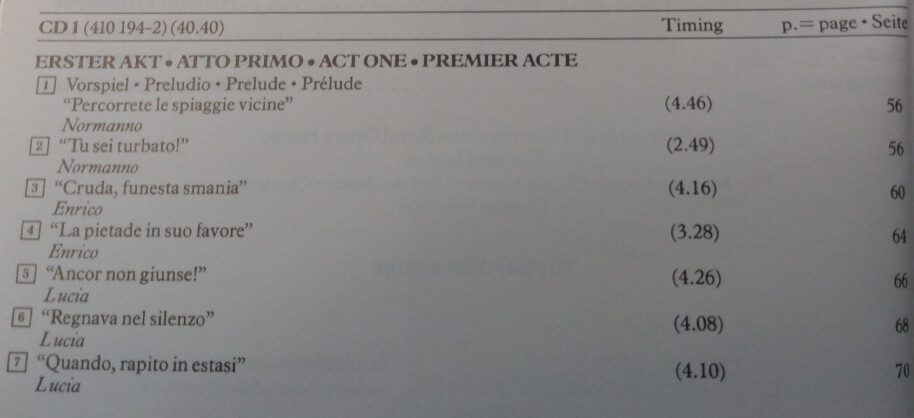
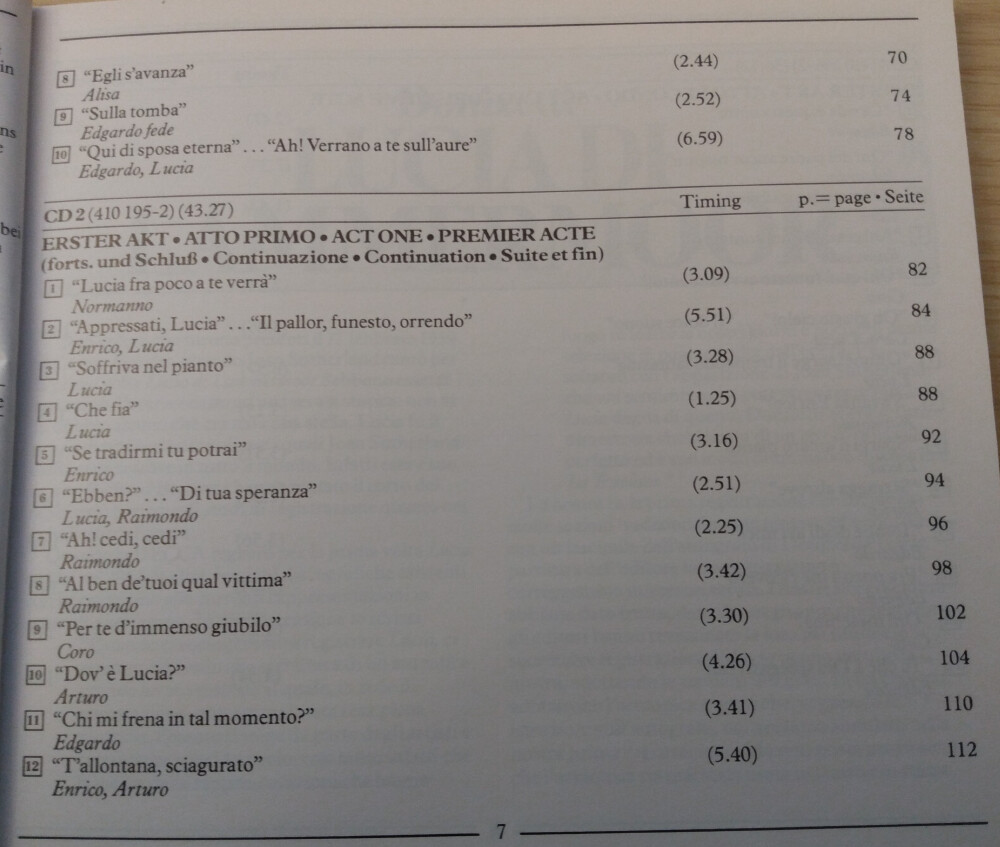
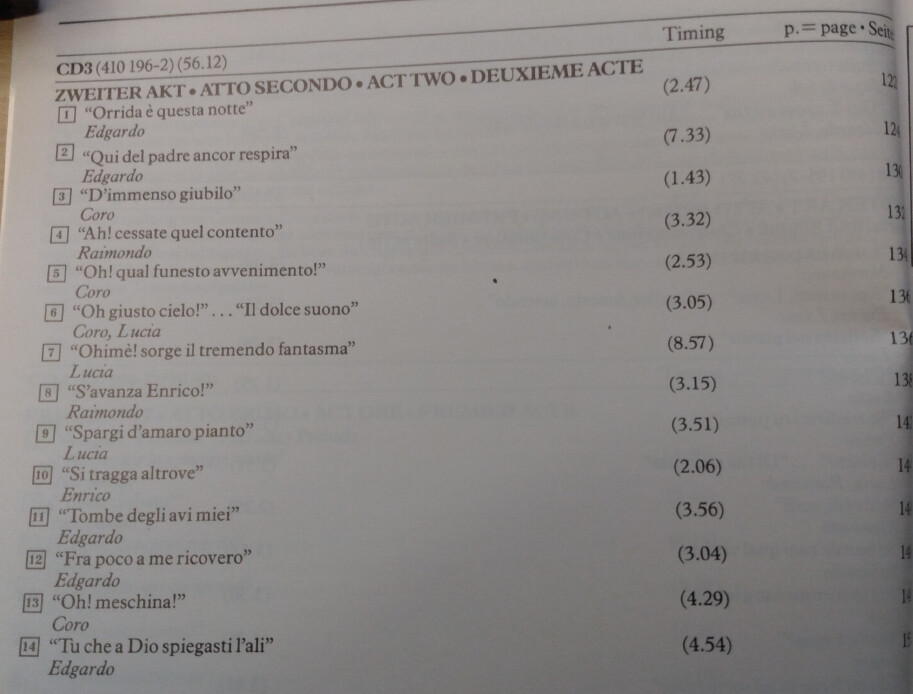
That’s act 1 on CDs 1 and 2 and act 2 on CD 3, and the libretto in the booklet splits it into acts the same way. The current tracklist on MBz has act numbers that match the CD numbers, and Lucia di Lammermoor - Wikipedia seems to agree. I don’t see anywhere else online that agrees with this booklet.
One of the things that makes the MusicBrainz data-entry hobby so, um… interesting is all of the, um… novel things that music publishers do with their track lists.
It looks to me as if the publisher intentionally presents what Wikipedia calls Act I and Act II as the first Act on this album, and what Wikipedia calls Act III as the second Act here. So, you have a choice of presenting what the publisher printed, or making some pretty major changes to undo what the publisher did.
On the whole, I tend to enter track names which reflect what’s printed on the release, and work names which are true to the score.
I think I would probably:
Enter act numbers and track names as printed on this track list.
If there are existing Recordings with names based on three Acts, leave them unchanged; otherwise, let MusicBrainz create new Recordings with names based on these track names.
Meticulously enter relations from each Recording to the corresponding Works. That will let the diligent reader see what is really Act I, Act II, and Act III.
Enter an Annotation on this Release, which says that the publisher presented this opera in two Acts, but that Wikipedia and the Work entities present it in three Acts.
Thank you for being careful about details like this. You are helping to make MusicBrainz better and more complete.
Thanks! That makes sense. I’ll update the track titles to match the booklet.
Thinking about this more, I think key factors here are the “continuation” text and the fact that all 3 headings are consistent with each other. If the headings were “Act One”, “Act One”, and “Act Three”, I might lean more towards thinking of it as a misprint[1] where they copy/pasted but forgot to update the text. But here everything looks internally consistent, just strange.
This does not apply to artists like P.D.Q. Bach of course. There I’d assume it’s intentional comedy. ↩︎