How to add mondegreens/misheards?

In Runet we have some iconic mondegreen “О великий суп наварили”, that millions of people know it.

Original is “Ultramarines Chant” which is Warhammer 40K OST

Its text is (is taken from YT comment by @NuKE_rus):

[Original text]
Agitatis Ultramarini!
Dominitis Ultramarini!
Non praestatis Ultramarini!
Nobilitis Ultramarini!

[English translation]
Come up, Ultramarines!
Win Ultramarines!
Don’t give up, Ultramarines!
Be famous, be famous for the Ultramarines!

But Russian speakers hear something else here:

[What Russians hear]
О шикарный суп наварили!
О великий суп наварили!
О шикарный суп наварили!
О великий суп наварили!

[English transcription]
O shikarniy sup navarili!
O velikiy sup navarili!
O shikarniy sup navarili!
O velikiy sup navarili!

[English translation]
Oh, what a gorgeous soup we’ve made!
Oh, what a great soup we’ve made!
Oh, what a gorgeous soup we’ve made!
Oh, what a great soup we’ve made!
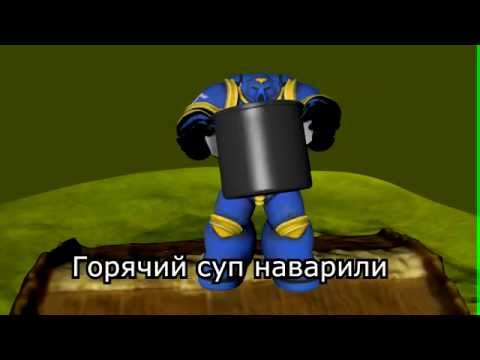
So my questions is how to add them? I suppose something like that
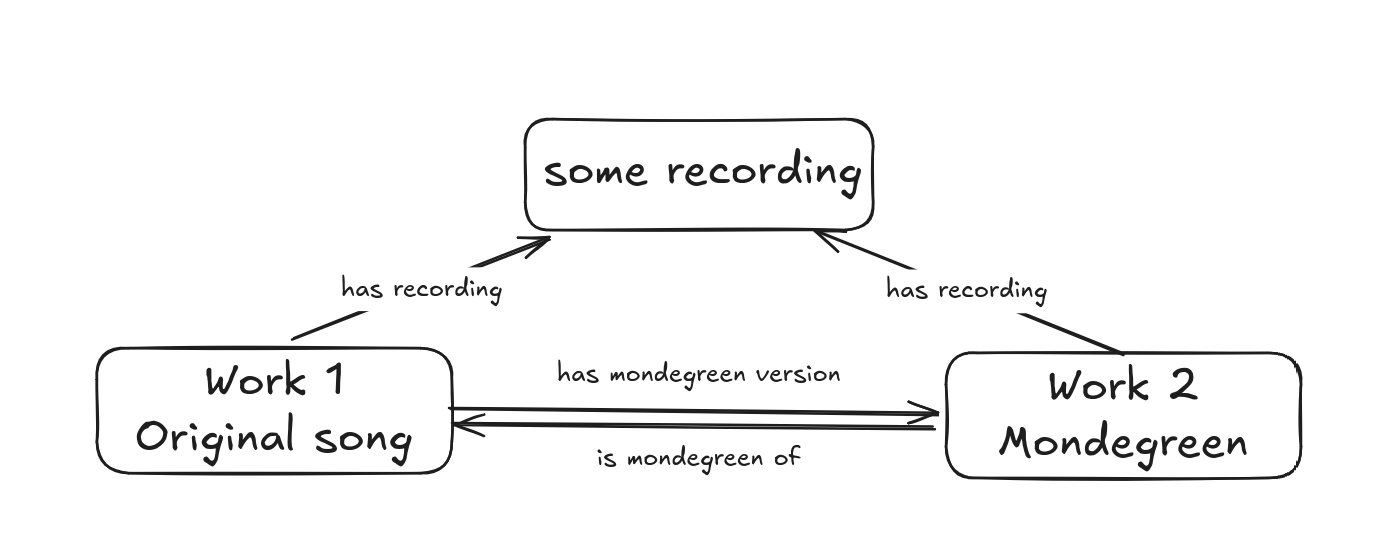
“has mondegreen/is mondegreen of” work-work relationship.

One more video explanation (in English)

Both recording and work levels, because mondegreens are often recording specific (can be recognized only in specific recordings because of the mix, accent etc), so it has sense to link them with recordings where they can be heard. In the same time it is understood as separate lyrics, that are different from the original work, which means it also has the sense to create a separate work for it.

4 Likes

Can relationships have a work as an attribute, like how the instruments relationship has both an artist and an instrument? It sounds like the mondegreen isn’t just specific to the recording, but to the recording and the work, since in a medley or similar, the mondegreen would only be for one of the works of the medley recording, right? So something like “<recording> is a recording of <work1> with mondegreen(s) <work2>, …” would represent the situation for recordings better, I think?

I can’t find a source for it now, but I think I read somewhere that Creedence Clearwater Revival once actually sang “there’s a bathroom on the right” instead of “there’s a bad moon on the rise” as a joke. Would something like that recording link directly to the mondegreen instead of the original work?

1 Like

I believe it was John Fogerty (the lead singer of CCR) who did this on a live album (tho CCR might have also done it somewhere, idk)

I suppose most of the time, people think of short phrases being mondegreened, like the “bathroom on the right”, “scuse me while I kiss this guy”, etc, but there are quite a few examples of this being done to a full song. these are also often called Misheard Lyrics, and are especially common with non-English songs being misheard into English (warning, some are not safe for work, lol)

just a small sampling of ones I’m familiar with. note that these videos use the original German, Swedish, and Romanian recordings of the songs misheard

Matt Rose has a video with some examples, and Know Your Meme did an excellent short video of the meme many years back

that said, there are covers of some of these versions

I think these have a place in our music database somehow, but I’m not sure exactly how would be the best way to handle these

3 Likes

If people are recording themselves purposely singing the entire song with intentionally wrong lyrics, I’d create a new work as a parody/translation of the original. If someone records a cover/live version where they sing a line or two wrong, I’d treat it as a recording of the original song.

Incidentally, now I have Finnish Duck Tales stuck in my head.

4 Likes

There are a lot of “flavors” of mondegreens.

For me, a mondegreen is a video of a song with mondegreen-ed subtitles added. Currently (as far as I am aware, browsing the relationships documentation), there is no way to add a recording-artist relationship for “subtitler” (I’m not sure what the official name of that is, haha!).

The type of “the singer changes some lyrics for a quip or due to a mishearing” seems totally separate to me. For both, I believe they should just be entered as recordings of the relevant work. Performers never exactly repeat a performance, so small variations are a given. Like Comrade_Mike said, the live and cover attribute should be selected as needed.

However, if the lyrics are completely transformed (a “true mondegreen” in my eyes), then that warrants a new work. I would argue it be classified as a parody of the original, translation implies the meaning of the lyrics being preserved, which is (as far as I know) against the idea of a mondegreen.

One edge case I am not sure of is an “improve mondegreen.” I’ve not seen it before (although I haven’t been looking), but I’m not sure how that would be entered. I think a cover recording of the original song would probably be good enough, unless the particular mondegreen becomes popular and more people perform it.


My proposal would be this: The “Other Version” work-work relationship should have the “mondegreen” attribute added. Mondegreens are not quite parodies. For now, I think parody should be used but there is enough of a meaningful difference between parodies and mondegreens to warrant another attribute.

Further, there should be a new work-recording relationship added. I am not sure what to call it! I think the broad “Based On” or “Adapted From” might work? Knowing what work a mondegreen is derived from is imported, but like libra said, often mondegreens are adapted from a very specific recording of a song.

This is what my graph would roughly look like:

Recording (let us say “Ultramarines Chant”)

→Recording of Work (“Ultramarines Chant”)

→Source of Mondegreen Adaptation (“О великий суп наварили”)

Work (“О великий суп наварили”)

→Mondegreen Version of Work (“Ultramarines Chant”)

→Mondegreen Adaptation of Recording (“Ultramarines Chant”)

Work (“Ultramarines Chant”)

→Has Mondegreen Version (“О великий суп наварили”)

→Has Recording (“Ultramarines Chant”)


Of course this an off the cuff idea, but maybe a basis for a useful set of relationships :slight_smile:

1 Like

That is the reason why I propose to create a separate work and to link it both to original recording and original work.

+1 for creating a separate work I guess

This is exactly what we try to define here

Of course I don’t speak about random little mistakes while performing. So I guess, we all agree, that if there is a huge amount or full song mondegreened, it is OK to create a separate work for this version, right? What about only some (3-6 or similar) lines has mondegreen/misheard? Is it enough for creating a separate work or undesirable in your opinion? What if there is a tiktok/short recording with fragment of music, where this misheard is used?

@UltimateRiff @Comrade_Mike @vacuousVersifier @dseomn

For now I would prefer a parody for the reasons @vacuousVersifier explained. But I think ‘parody’ has too common meaning and ‘mondegreen/misheard’ is more concrete. Not sure if it should be a separate relationship at all or an attribute of ‘parody’ relationship. Again, I’m asking all who took part in this topic.

For this specific case with 1-2 lines only in one recording I guess it is more logical just to write about that change in an annotation of that specific recording. But if this change is repeated and performed in many concerts/recordings, perhaps it can be added as separate versions as mondegreen or just later version (depending on a character of lyric changes)

Do you mean covers and other performing of mondegreen versions? If we have separate works for them, I don’t see any reason not link them to these works with ‘cover’ attribute.

Pretty much similar to my scheme, except for ‘Source of Mondegreen Adaptation’ rel, which I like. Thanks for this propose!

when y’all say “original recording”, do you mean the misheard lyric video, or the audio recording used for the misheard lyric video? I’d personally prolly favor the former myself for that new relationship

and yeah, I’m fine leaving the “bathroom on the right” type mondegreens to the annotation, unless it’s more than a couple lines, or if it’s performed multiple times in the same way (with the mondegreen in the same spot), then I might say new work

I think technically translation just means it’s in a different language, but I could be misremembering. that said, if we can get two new relationships or attributes, one for mondegreens (same language as original) and one for soramimi (different language than original), we wouldn’t need either parody or translation, in theory

I’m not sure what you mean by “improved mondegreen” here, is it like the Caramelldansen cover example above (the 4th video in my previous post), or is it a video that’s more than just subtitles on an existing music video like the Numa Numa example?