How should a jazz release be credited when its cover features one artist prominently but also lists other musicians? Specifically, this came up on edit #122251074 (and associated RG/medium/recording edits) for this release:
This is a digital media release added from https://atleyking.bandcamp.com/album/unconditional, and the top of that page only credits Atley King (which I believe is the default for Bandcamp). The cover image says “Atley King” in a larger font and then lists King again with the other musicians in a smaller font.
I found similar-seeming releases credited to all of the artists:
I don’t think that the style guidelines explicitly say what to do here. Style / Release - MusicBrainz says “In general, you should just enter the artist(s) as shown on the release,” and Style / Artist Credits - MusicBrainz says “Artist credits should generally follow the actual credit used on the release / track, including the join phrases.” I’ve always interpreted that as meaning all artists regardless of prominence in how they’re listed, but it might be better to be explicit about that.
(This may also touch on one of my least-favorite debates, “What do you do when the webpage has different data from the cover image?” :-/)
I would not pay attention to information on the website (or maybe only for the RG). I would look at the cover, the spine. If there’s only one artist, or one of the artists is much more prominently presented, I would make it a solo album (at least this release). It often depends on your personal judgment and there is no 100% correct solution.
EDIT: I would also consider how much the artists contributed to the album, but only for the release group, not for a specific release.
I usually list all if they are presented that way, i.e. Main artist feat. performer. However, when it appears that it’s just listing the band members of the main artist or they are greatly diminished in font size without any join phrases on the cover, I typically don’t. Yes, if there is physical media available, I’d usually use that over the shops. Look at spine or medium labels.
Update: Example would be the Loose Blues above by Bill Evans. I think that should only be credited to Bill Evans because that’s how it’s listed on the spine. The others are performers listed on the back cover art.
This came up again on an edit I thought would be fairly uncontroversial. I think the most common solution, which is followed on most classic Blue Note releases that more often than not lists the entire lineup, would be to just pick the one name that they put most priority on. Usually, this is the only name on the spine and medium. The front cover listing everyone that plays on a jazz album isn’t uncommon.
I would probably also make an exception if they do not credit the entire lineup, but only partially. An example that came to mind is this album, which credits three musicians, but there is a bassist and drummer not listed on the cover anywhere.
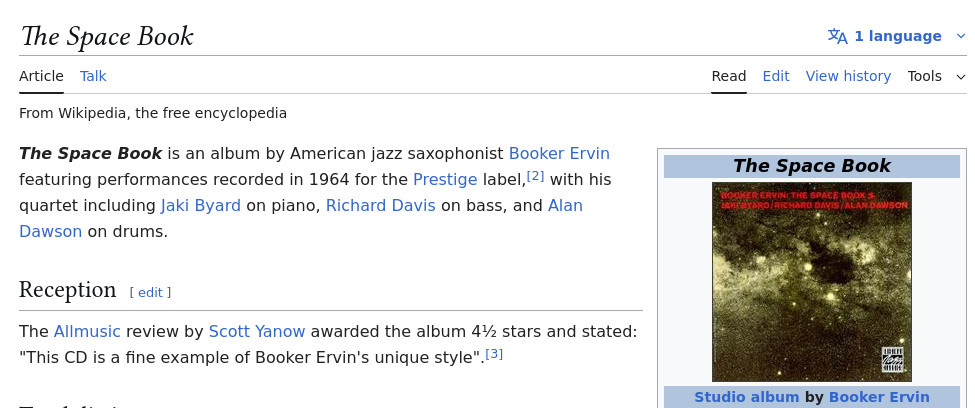
Every single release I can find of the release in Edit #133363628 - MusicBrainz going back to 1965 (original release) has all 4 names on the cover. There are no releases with only Booker Ervin on the cover.
Presumably, the artists involved (including Booker Ervin) wanted all the names to appear together on the cover for a reason. What’s the purpose in ignoring that?
The release, and the release group, already had complete info. The edit is removing info. Removing info does not make the entry more accurate wrt to the actual physical releases and what’s printed on them, is a destructive edit, and as such generally needs better justification than “I prefer it like that”.
There are plenty of jazz releases that have a single artist as the leader, and only feature compositions from that single artist, and only have that primary artist on the cover, for every release.
There are also plenty of jazz releases that have a single artist as the leader, and only feature compositions from that single artist, and explicitly have all artists listed on the cover, for every release.
We can either have an opinion about what the artist list “should be” (in our opinion), or the database can simply respect, for each release, the cover/original release intent and capture complete information, implicitly distinguishing between the two types of release. Or at least, that’s my opinion, and as mentioned, the guidelines aren’t specific here, so “respect the original cover’s complete listing, and the precedence it uses” is all I can go by, and seems a better rule of thumb than “editor decides the information on every release cover going back to 1965 is wrong, or needs to be edited down”.
I’m sure there are cases where over the lifetime of a specific album, at a certain point, the artists listed on the cover were changed. Perhaps a reissue dropped or changed names, etc etc. Whether in that specific case, the release group overall prefers “majority of releases” or “original release” for its artist list isn’t something I particularly care about, that’s a discussion to be had.
I’m happy to change to abstain / be outvoted (that’s why the voting works the way it does) but I don’t think my objections are unreasonable - the release has what the release has, like it or not, the edit was removing information present on the release, and either we respect the releases (majority of them/original release/etc) as the source of truth or we invent a consistent rule as to why we shouldn’t respect them.
They also listed one artist with way more focus, and only printed Booker Ervin’s name on the labels and spine. So, what is the purpose in ignoring that? This is also a form of intent, to denote the album’s leader vs. the sidemen. Instead of focusing on the names being printed on the front cover, we should instead focus on why they were printed on the front cover and how they were printed on the cover. Is it meant to convey the main artist for the release, or is it just to list additional musicians for advertising purposes, printed in a way that clearly conveys which musician is the main artist?
This edit is not removing information, performers have relationship information already.
This is a long post and I don’t really know how to respond to it other than to point to the vast majority of jazz albums here being credited to the main artist. Are all 36 issues of this incorrectly credited too? My edit is changing it to follow what I believe is fairly established in practice (unfortunately not in guidelines).
Another example, with two artists given priority, listed before the title. Having all five artists here would be ignoring the intent the graphic designer was trying to convey, only Metheny and Coleman appear on the spine and medium.
would like some more eyes on this if possible, currently at 1 yes/1 no. not telling people to vote one way, read the arguments and make up your own mind.
Ach too late. I would have voted no, as the artists are all on cover, like the title, and whatever the spine says because this is too long for the spine, where they will sum up to keep readability.
Thank you for voting. I don’t want to be rude, but given your response, you don’t seem to understand the main argument made by me and ernstlx.
The point isn’t that the spine/medium is more important than the front cover, it’s that the spine/medium follows what we already inferred from the front cover, that Booker Ervin is the main artist, since he is listed with the title, and the other musicians are listed after him. If the spine and medium said otherwise, it would be a reason to list them all.
Secondary artists aren’t kept in the database for jazz (see the Cannonball Adderley example), because their purpose is on a relationship level. Covers sometimes list the entire lineup with less priority (smaller/different font, different colors, or in this case, after the album title). This isn’t shortened because of spine constraints, it’s shortened of a long standing jazz album tradition to credit albums to a leader, that is followed on the majority of jazz releases in the database with similar cover art (I can easily make a list of 50 similar album covers with 10+ releases in each release group if anyone really wants it)
A quick list of eight famous albums, all by different main artists, for consideration. Edit #133363628 closes in a few hours, but I don’t think crediting those albums like that would be a welcome change for users of the database.
The only thing that supports a collaboration is the presence of the names of the band members on the cover. Everywhere else (labels, spine,…) only one name was printed.
This cover design was used for almost all releases and the album was never considered to be a collaboration.
I missed the vote but I would have voted yes. In most cases, and I believe this is one of them, only the leader (Ervin in this case) is under contract to the label. The leader, along with the producer, chooses the repertoire, the arrangements, and the accompanying musicians. The leader’s role is qualitatively different from the other performers. This is reflected in most jazz references (e.g. the Penguin Guide) and discographies.
Also, back in the 50s and 60s and probably well into the 70s, artists frequently had little or no say in the actual cover design. (Thelonious Monk’s famous Underground, from 1968, was entirely the creation of Columbia’s marketing department.) So it’s likely “cover designer intent” more than “artist intent”.
This is what I thought about this album:
Why was this album even called “Space Book?” It has absolutely nothing to do with space. Neither with the sounds you hear nor with the titles of the tracks. But space was very popular in the 1960s, the era of the race to the moon.
Consider also that Prestige released four “The ___ Book” albums by Ervin. Two of them, “The Space Book” and “The Blues Book”, listed all musicians on the front cover. The other two, “The Freedom Book” (with identical personnel to “Space”) and “The Song Book” (same bass & drums, Tommy Flanagan on piano in place of Byard) have only Ervin’s name. To me that’s a further indication of “cover designer’s intent”. The accompanying musicians are no more or less important to the records they’re named on than the ones they aren’t.
Since 2/3 of my edits on this release group passed, and I got two comments from other editors saying they would vote yes, I resubmitted the one that failed.
The reason for the four album titles are that they’re obvious puns on Booker Ervin’s nickname “Book”. I have no idea if he came up with the names or not.
I would have expected more experimental sounds from a Space Book. It doesn’t look like the album was meant to be particularly experimental. 2 covers, one re-recorded track (Mojo) and only one new composition. But it is well possible that Booker himself thought the title would be a good idea.
 Though I think this a Booker Ervin album. (it is even on Discogs)