A stage (sub)event can have a child event relation for one single performance in addition to the direct artist performer relations.
a) Is that the proper way to handle complex performances like in the sample mentioned below?
b) The only other way to model this is a setlist, I think. But I don’t have much experience with setlists.
c) If there are multiple artists that perform together then you give them the same play time. (mentioned by @sanojjonas ). One can even use the other Event-Artist rel types to make the information more exact. In example guest performance for artists who join for one or a few songs. If available. It may also be considered to allow to give that guest performance rel the exact time if known.
If anyone has a opinion, lets discuss and I think we should mention one or both methods in the style guideline.
If we take a), I think we should add a sentence about the naming. Is ‘Wacken Open Air 2015, Day 3: Rock Meets Classic’ enough or to we need ‘Wacken Open Air 2015, Day 3: Black Stage: Rock Meets Classic’. And the event type is concert then? Or festival like its parent events?
You know where it was discussed and what was the consensus?
And I don’t want to force anyone to use the pattern we will add to the guideline, I want to make it an option where more granularity is needed, like in the example with Rock meets Classic, just for one performance. The rest will stay the same.
But your approach is also valid I think. Then the guideline should be, that the play time should be exactly the same to enable matching in clients/UI. Will add it above.
I found another way to represent this. The guest performers can be added at the stage sub event, but then we don’t know on which performance they was a guest to.
again, you could just give the guest artist the same playtime as the main artist. that would indicate that they where on the same stage at the same time.
if we would do something similar i would still leave the stage name in the event name
so i think it should be:
Wacken Open Air 2015, Day 3: Black Stage - Rock Meets Classic
i don’t remember anymore
i also remembered that it once was suggested to always make sub events for earch perfomance.
in my opinion it would make it more consistent and clean and stuff.
BUT
that would mean that all events would grow exponantionally, and it already is so tedious just making the festival/day/stage events, if we have to add a performance to it aswel.
the bonus on the other hand would be that you could have a collection of performaces where you went to.
Ahhh, sorry it was late yesterday. of course, that is also a good way. So that makes my “new” option d) a copy to c) Just making clear (for me) that we can also use the other Event-Artist rel types (like guest performance, support artist, …) to make the appearance more exact. For guest musicians I can even image giving them the exact (approximated) time to match them to a performance. Because often a guest musician just appears for one song. Then client side we can look if a certain time is in range of another and show that information as we want.
in theorie yes. but matching exact number is easier then checking if it is in between a certain range. especially if the playtime is from 23:45 until 01:00
I already make the times an time object in the programming language i use (Kotlin), so there are convenience methods for calculating if a time is in a range is in another range.
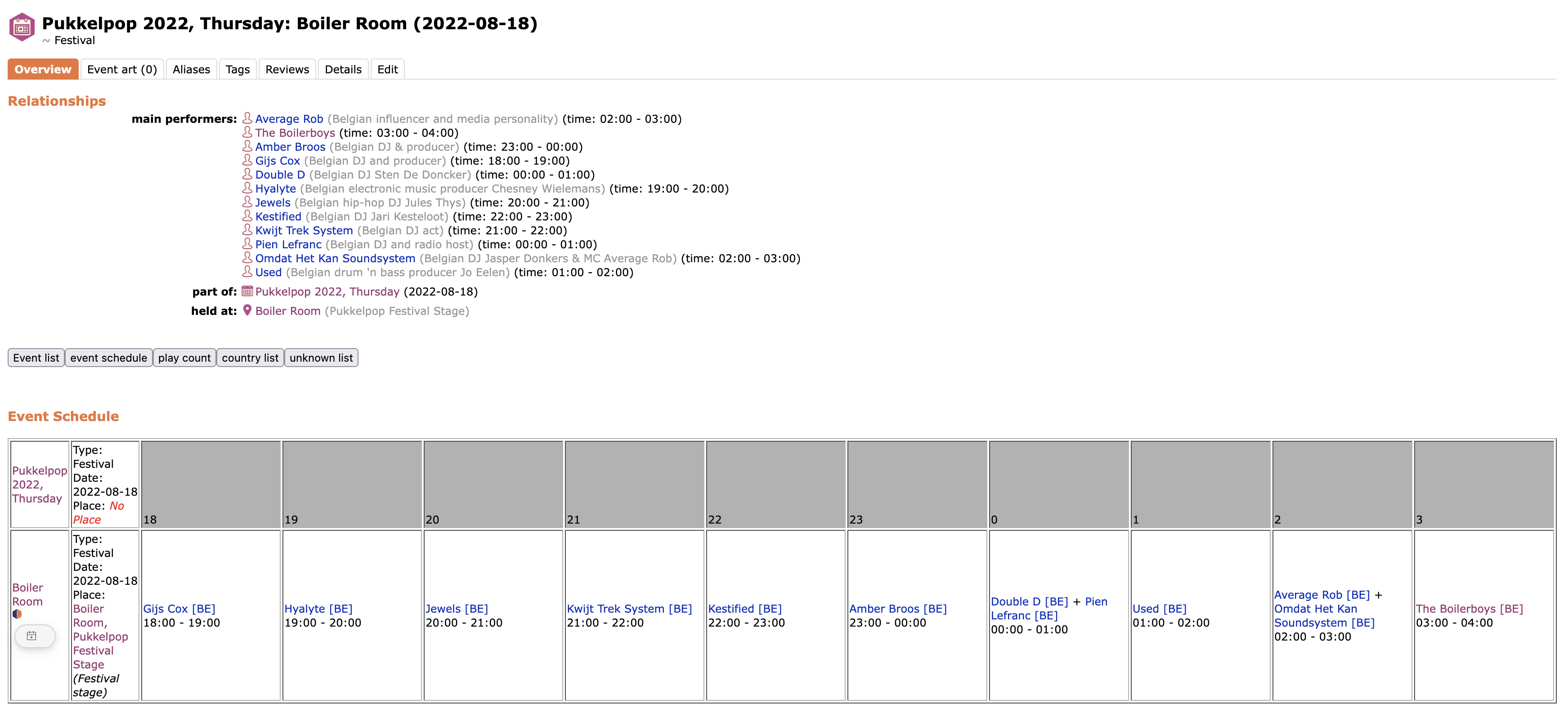
 Just making clear (for me) that we can also use the other Event-Artist rel types (like guest performance, support artist, …) to make the appearance more exact. For guest musicians I can even image giving them the exact (approximated) time to match them to a performance. Because often a guest musician just appears for one song. Then client side we can look if a certain time is in range of another and show that information as we want.