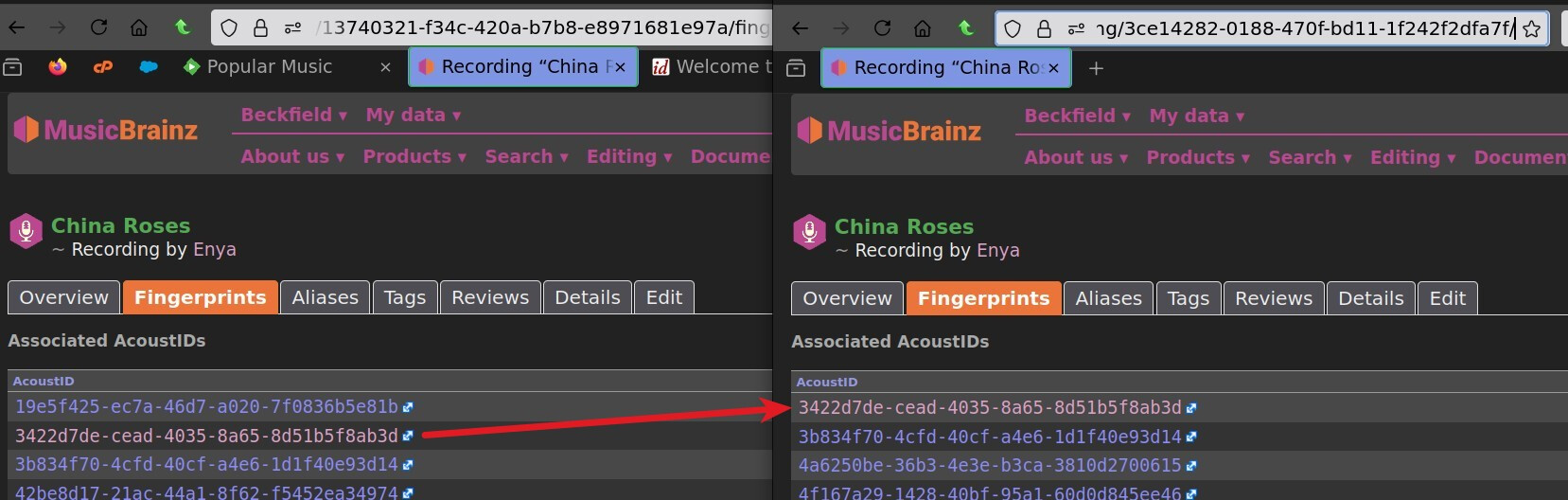
I’m thinking these two recording should be merged, but I’m unsure. They have the same ISRCs, and AFAIK, Enya only recorded the song once (I think that’s true of most of her work). But they both have more than ten AcoustIDs attached to them. Many are the same, but not all. The lengths differ by 10 seconds.
On the AcoustID site, there is a feature to compare two AcoustIDs. It is not well documented, but it seems to me that the Offset is supposed to allow you to line up the fingerprints, to allow for different cropping. Does anyone know if this is a correct assumption?
So I chose a fingerprint that is common to both recordings:
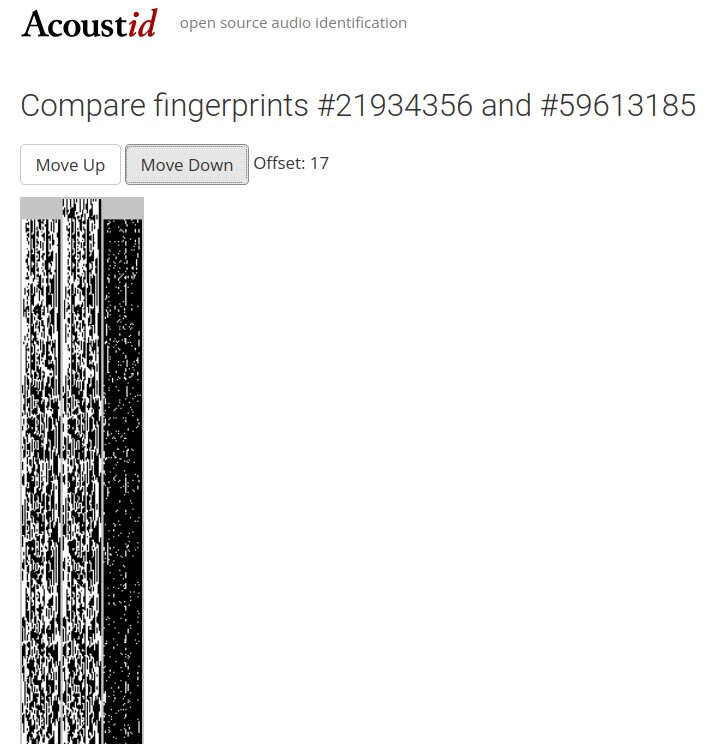
If you get the Offset to +17 between these two IDs, the third column turns nearly all black. I presume that the darker this column is, the more similar the fingerprints are, and truly identical fingerprints would result in a completely black column. However, when I compared these two fingerprints, the result was not a completely black third column:
This is the first time I’ve looked at AcoustIDs this closely, so I’m unsure whether I’m understanding what I’m seeing, or whether these recordings are truly identical. I’m hoping for some insights from folks with more experience in this area.
To me the two recordings have enough shared AcoustIDs that I’d consider them the same, the mess of misassigned AcoustIDs doesn’t get significantly worse by merging imo (though iirc there’s a bug when merging recordings that only the AcoustIDs of the merge target are preserved and all others are lost - which might or might not be seen as an improvement in cases like this).
Yes. It implies one track starts slightly later that the other. A small bit of intro is missing. I can’t tell you how much time a unit of offset is equivalent to. The fact the rest of it is so black tells you it is that same recording.
Seeing 9 seconds difference I’d want to check by ear. Or audacity. Where and why are those 9 seconds trimmed? Sometimes this is due to how it fades into tracks around it. Sometimes a bit of intro\outro is trimmed.
Multiple rogue AcoustIDs are not unheard of. You only have to watch the forums to see how some people use Picard to know how that can occur. It is worth noting how many samples something actually has as a gauge of how much it can be trusted.
Also remember if someone incorrectly links a track, submits an AcoustID, and then later moves that to a different release then they can’t move the AcoustID.
Different mastering also gives you different AcoustIDs.
I find one of the best ways to start understanding the differences is comb your own collection for duplicated tracks on compilations, and look how their acoustIDs compare. And look at what they look like in Audacity. Load them all up at the same time and look at them visually
I notice in your chosen example there are five AcoustIDs common to both, which would give me a good feeling about a merge. But seeing how they are split now I would likely leave them unless I could audibly compare
My guess is the original “Memory of Trees” version has some little part of the previous track attached to this recording. “The Best of” version then likely trims this off. Or just plain drops a few seconds of intro.
If you are unsure, it is better to leave separate. Trying to untangle a bad merge is a real headache and much of the original evidence is lost forever once AcoustIDs are incorrectly merged
I’d merge these. Close length, shared acoust ids, one recording only on compilations, no evidence of a second recording.
Note that comparing the shared acoustid as I understand you did doesn’t prove anything. I use this kind of comparison when there are two recordings that both have disjoint sets of acoustids. Then seeing that kind of alignment lends support to the merge.