Adding of 'mashes up' as work-work relationship

Explanation

Now we only have ‘mashes up’ recording-recording relationship, which is used when many specific recordings are mashed together and it covers 98-99% of all mashups. But sometimes there are mashups that can’t be added as mashup of specific recordings, because they are mashup on work level, where musical ideas of two songs/works are mixed and not their specific performances/recordings.

To solve this problem I want to open a ticket with asking allow ‘mashes up’ on work-work level as well and ‘remixer’ on artist-recording level.

Some examples of these mashups:

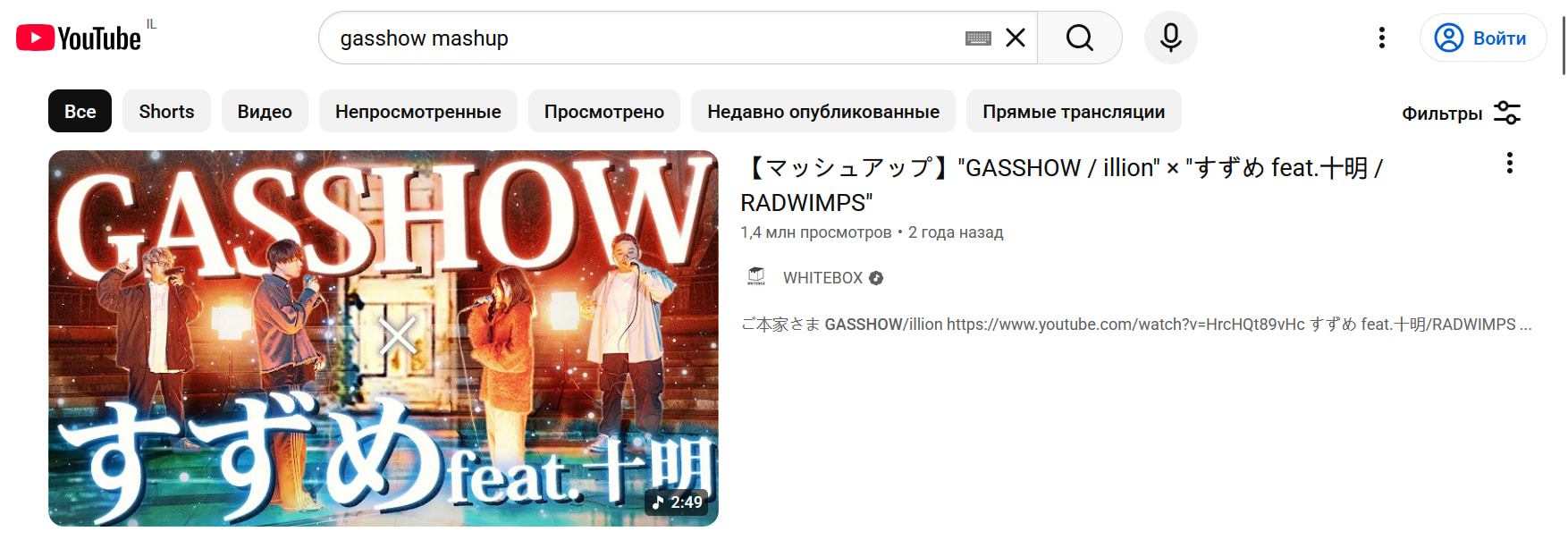
“Gasshow x Suzume” by Whitebox

It is a mashup of

  1. “Suzume” by Radwimps
  2. “Gasshow” by Illion

But this mashup doesn’t use original recordings at all. Instead of that they only mixed the musical ideas of these 2 songs and performed this mix and this recording is fully recorded and performed by them.

A Mother’s Love, A King’s Duty - VS Ceroba and Asgore Battle Theme [Undertale x Undertale Yellow] by Jova

  1. “A Mother’s Love” by Undertale Yellow team
  2. “Asgore” by Toby Fox.

A Hero At Their Precipice (Precipice x Battle Against a True Hero)

  1. “Precipice” by Aaron Cherof
  2. “Battle Against A True Hero” by Toby Fox
2 Likes

It seems more appropriate to use the existing ‘based on’ work-work relationship (or one of the many other work-work relationships available)?

2 Likes

Hi! I know and understand I can do that with this relationship as I did many times with other songs. But ‘mashup’ is better defined and makes it clearer what exactly was made/happen with works, while “based on” is too common and can be used in too many senses and cases. So why do you think it is more appropriate?

It seems to me that ‘mashup’ has a specific meaning, which is to mash up two recordings.

Well, I don’t think that people separate recordings and works in their everyday life. In my opinion these cases can be named mashups as well as we name recordings, because exactly same operations are made, just on different levels:

  • some part of two or more recordings are mixed; in some parts only one song is kept, while other is not; original recordings still can be recognized
  • some musical ideas of two or more works are taken and mixed; in some parts musical ideas of only one work is used; original musical works still can be recognized

So definitely I believe it is exactly the same thing, but with different entities.

Also if you will google ‘gasshow mashup’ on YT, you will get this track in the beginning of the results. I checked this many times in incognito mode and with different VPN connections. It makes me believe, that other non-Japanese listeners search this track with using of the word “mashup” for it and I’m not alone.

a relationship like this could be useful in other areas too, like for church hymns, I’ve been wondering about putting in a ticket like this myself actually, specifically a way to note if a mashup uses the vocals or instrumental (or other part) of the original song

I will say, in the past I’ve also used various “Version of” relationships to link works where it seems necessary, like a few mashups where they use sentence mixing to make the vocalist sing a different (third) song

https://musicbrainz.org/work/13515680-a705-41fb-b251-9f32fd6f2854

(not technically a mashup, but it’s a good example anyways, I think)

edit: proceed with caution, the song is quite NSFW, lol

I’ll try and find a better example later

1 Like

Personally I use the “Quote Lyrics” and “Quotes Music” relationships for mashups.

https://musicbrainz.org/recording/657e184c-b943-4801-851a-49c29b5a8370

https://musicbrainz.org/recording/de53354e-6095-47ad-890e-d680df911034

1 Like

I always thought the Quotes relationships were for short quotations (like, no more than about 20 seconds), not for whole pieces… that’s why I’ve been mostly using “Based on” or “Version of” (unless of course it is a short quotation)

2 Likes

Oh yeah, it actually is…

We need a mashup relationship then. Whether it uses Lyrics or music can be a relationship attribute. Making a ticket :slight_smile:

2 Likes

Feel free to upvote and add more info if needed

4 Likes

In my mind, the ‘based on’ relationship is for a when work is.. based on another work. It’s not a new arrangement of the work, it’s not a subsequent revision, it’s something that takes some core idea from a work and uses it to create a new work that is still meaningfully different.

A mash-up is a much simpler and more strict case than that. It’s just an audio recording being mixed with another audio recording. The new work is not based upon the old work, it is the old work, being used as a long-form audio interpolation.

So you might ask, why not just have it as a performance attribute? Well, sure. That’s the situation for medleys. A recording can be a performance of a work as a medley, or it can be a recording of a distinct work which is made up of other works, using the ‘medley of’ work-work relationship. I see no reason why there should not be a similar situation for mash-ups.

Furthermore, the ‘based on’ relationship’s guidelines section seems to specifically suggest that this the intended structure:

Do not confuse this with medleys, mash-ups, remixes, etc.

ALSO, included in the style guidelines for works, since 2011:

Examples of works that are distinct:

  • …
  • a mashup of multiple original works

…which was added “based on extensive work by development and style council”.

1 Like

some additional random thoughts, after a few more days of further thinking:


Medley is a very specific idea, when you think about it. It has to be a new arrangement, based on old compositions, newly performed for this specific purpose. It specifically cannot be a digital (or otherwise) combination of existing audio recordings. Given that fact, it seems that medley is a supported relationship just because that’s what has only been possible for hundreds of years. Let’s keep up with the times and add this new type of relationship for works!


If work relationships are added for mash-ups, I think it might logically follow that work relationships for dj mixes be to added as well. While it may be niche, there are some complex cases where a dj has added their own spin on a recording enough for it to warrant new work (both in my personal opinion, and in the opinion of rights societies). For example, the dj could have their own rapping or spoken word in the track, or little vocal samples from other recordings interwoven in the track, but at the end of the day, it is still a dj mix (mixes into the next track smoothly, uses crossfading, beat matching, etc.) of an existing recording. Right now, I am using “other versions” or “based on” for this, but this doesn’t seem right for the same reasons as I laid out for mash-ups.


I’ve been going back and forth about whether I actually agree with my own points here, mostly hinging on the interpretation of the “based on” relationship. If you take a more broad view, you might be able to accept that ‘based on’ should be used for mash-ups (or complex dj-mixes). The new recording, after all, does use the two original recordings as its “base”. The guidelines section does also say “This is used when a new work is based on or includes (parts of) another work”. Considering “parts of” is parenthetical, this does seem to read as “use this relationship when one work includes another work” (which is exactly what a mash-up is). I still cannot square this with the fact that the guidelines specifically say not to “confuse this with medleys, mash-ups, remixes, etc.”, but this is probably an oversight that we are coming to the objective conclusion about right now! (hooray!)

P.S. while writing the end of this I realized that when I was talking about a dj mix, I was really just describing a remix that happened to be part of a dj-mixed release (although the two ideas are very heavily intertwined for some artists, so it’s hard to say). But probably a “remix” work-work relationship, not dj-mix. But maybe both?

4 Likes

Sorry if this is veering off topic, but regarding Levi’s P.S, I would like to mention I find it quite odd that remixes are rarely considered to be new works. In the EDM sphere, remixes are very commonly entire new arrangements and compositions that at most sample fragments of the original track. In these cases the remix is effectively a “mash-up” of the original work and the remixer’s original composition. This composition is ignored though, and remixes are near universally labelled as derivative works.

Meanwhile mashups and medleys that feature only arrangement and no original composition are considered to be new works. Ironically if the remixer released their composition as a solo work first and then later mashed it up to create the remix, then the remix would be a new work.

Arguably this stems from artist intent. If they title a track “X (remix)” then the remixer themselves clearly considers the work to be derivative, whereas if they give it a new title altogether then that may indicate they consider it to be its own entity. However this would also apply to a mashup artist titling their track “X / Y (mashup)”. That is also a title that clearly considers itself to be derivative.

I just find the threshold for what is considered “new work” to be a little inconsistent. If mashups clear the threshold then I believe most remixes also clear it with flying colours, or even most DJ-mixes as Levi pointed out. What is a DJ mix if not a long string of mashups arranged live?

2 Likes

This is a point I agree with. If remixes are not new works, then mash-ups should not be.

A mashup is a recording relationship where two recordings are linked in style similar to a remix.

I totally agree. After writing this post I read even more relevant other forum topics and was pretty baffled that the arrived upon standard was that all remixes should be part of the original work unless they are almost entirely different from the original work. In my mind, we should be much more willing to separate works (and have descriptive relationships to link them). I was going to make another more complete forum topic addressing remixes specifically but I haven’t had the time…

Here are all of the relevant forum topics I found for convenience:

(this specific post by reosarevok is particularly… interesting, but the entire topic is relevant)

3 Likes