Maybe it could be used to translate the site in languages we don’t have yet.
1 Like
I had almost 5k edits in 24h yesterday with casual edits while working on String Theory userscript. All 5 top editors of previous week use it.
I don’t doubt there are few errors, but I am pretty certain that other things are legit. So this is all automation using AI to develop scripts, but then using it without any bots at all. I do double-check most of the stuff but all scripts that mass add stuff (e.g. Credit Hoarder or ISRC Scout) do so only for 100% confident relations, give options otherwise, and all must be confirmed by human. I also fixed bunch of errors (mismatched artists, style, barcodes etc.) which is also driven by script dashboards in which such stuff are highlighted. I didn’t expect this working so good when I started this a month or so ago. It is so good that I changed stance of several things like oversplitting releases - I now work on entire release group in less amount of time that took me to edit single release before, while producing orders of magnitude better quality of input.
This IMO proves that good toolset is extremely important and that good automation has no alternative (certainly not easy thing to implement judging from decades of experience in the domain). Idempotency is big thing too, so automation can be repeated by others and not locked behind a single machine.
AI is imenslly useful but as with any powerfull tool, there are dangers. That doesn’t mean we shouldn’t use them, but to better design the systems around them.
FYI:
The idea is a kind of “bot-only” queue, not direct edits. We could provide an API for it, so submissions to the queue can be automated, but acceptance cannot. If nobody accepts the changes, they stay in the queue until they conflict or whatever.
Acceptance should be automatic as well depending on human decision (in ad hoc or some smart manner). Automations can be more or less problematic depending on the domain and downstream effects involved. For example, above-mentioned alias bot is an example of fully automated domain - if errors are rare or easily recoverable (based on history) its malpractice to slow down or halt the process just because its done by bot (e.g. we need merit based approval and periodic randomized inspections).
I will note that a graph like that is deceptive. There is zero record of people checking edits that don’t need a vote. Daily I check hundreds of edits, but rarely need to vote on them. I will pick up and point out errors, but that is a tiny number of votes needed compared with data invisibly checked.
This is what scares me. If a bot makes a few thousand edits in one of my subscribed artists I may not have the time that day to check everyone of the edits. A bot can create thousands of edits for no cost, but us editors checking those edits only have so much time. (The edits adding streaming links already make me scroll quickly potentially missing items in between that needed a check)
This is why automation worries me at its potential speed and volume.
I am also another person who agree that merges are a bad idea. Impossible to untangle. It is bad enough watching editors merging recordings on just length and ISRC matches which cause enough trouble on their own. (Example: ISRC is too often attached to the wrong recordings on a VA collection. The swap of album\single versions that don’t matter for payment, but does matter when merging Recordings.)
If MB had an “Undo” option on edits. The current system means many edits once done we don’t even know where they came from. Merge two recordings and after they complete you have zero trail… If there was an Undo" possible to untangle mistakes then I’d be less worried.
6 Likes
Humans make mistakes too but many edits (including destructive ones) are not reviewed at all.
I’d suggest those who don’t vote to do it for a month and try to enter the Top 25. It’s not hard when a two-digit amount of votes suffices. (Bonus points if you reach the yearly Top 25)
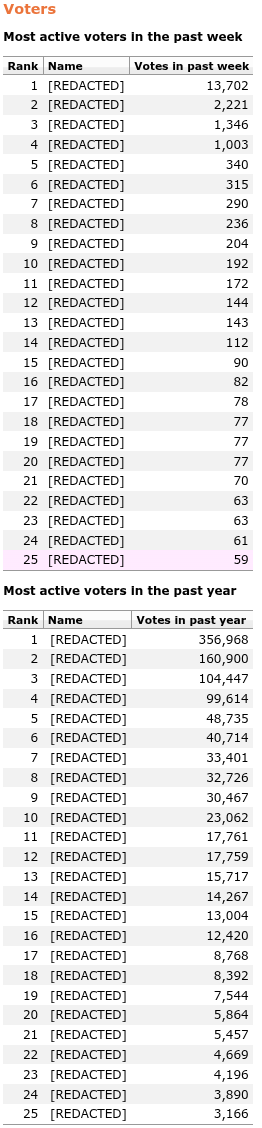
I’m already trying to reduce the voting queue by approving lots of trivial stuff:
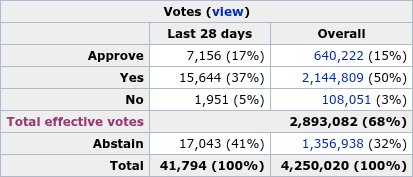
As a famous person once said: Voting is important
There is: Abstain
There are limits to how many edits are allowed to make. The same does not apply to human editors and there are far more human editors than bots.
So, the problem is humans and not bots using the same standards?
3 Likes
I mean the edits that don’t even qualify for a vote. Many edits are Auto Applied, but still need checking. I don’t just check data that needs a vote, but all edits on my Subscribed Artists. I only vote Yes when I have checked the data and a cross reference. Ditto No. I don’t need to Abstain when I have nothing to add. Generally I use Abstain when I talk to the person and ask a question.
We all check data in slightly different ways.
I think you misunderstood what I was saying. Humans make errors. Humans with scripts make errors faster. AI will make errors. Nothing is perfect.
Part of my point there was that you can’t reliably merge on ISRC due to how VA collections handle ISRC.
3 Likes
First, as others have already noted, be very, very careful with any task, which requires entity-matching.
I can tell you one example of AI-based edits gone wrong: Some time ago, somebody posted a Wikidata-query for finding bands, whose Wikidata-entry are linked to a Discogs artist, but not to a Musicbrainz artist. I wanted to create the missing links, so I went through the list (of those entries with a German or English Wikipedia page). First step in the process was, to check, whether the Discogs-link is correct.
Well… A lot of those links were created by some AI-based bot. Of those links, which had an ambiguous artist name on Discogs, approx. half were linked to the wrong entity and had to be fixed. By the way, there ar more artists with ambiguous names, than most people would expect. And even in those cases, where a single band with that name was on Discogs, sometimes that band was not the same as the one mentioned in Wikipedia. The majority of those wrong links were done by that bot. I ended up fixing a 3-digit number of links, and I think it was not a small one.
When I reported those errors, the leader of the team which has developed the bot told me “Good, our AI will learn from it!” - I have some doubts, that an AI, which is only told “that was wrong” without exactly what was wrong and how to avoid the mistake, will automatically draw the right conclusions from a relatively small percentage of errors. And only a part of those were detected, because I only checked those with missing Musicbrainz-links.
I think some edits should be automated, but creating edits without being aware, what could go wrong, can introduce lots of unnoticed errors, because there are a lot of artists in the long tail, which will be checked by very few or no editors.
Some notes and examples, which could confuse an AI:
- Even if the artist name is not ambiguous, it doesn’t need to be the same.
- There was some 50s band from NZ with the same name as a band from UK, who has covered a song by the other band. The single was assigned to the wrong one.
- A recording should be at least a recording of the same work
- Bon Jovi has performed “It’s My Life” by Bon Jovi and covered “It’s My Life” by the Animals in a live-session.
- Rose Lauren has recordings of her song “Africa” in French and English versions. That is not uncommon for French-speaking artists.
- John Williams (the classical guitarist) has performed the main theme of Schindler’s List by John WIlliams (the film music composer).
- When an artist name is ambiguous, very few editors disambiguate the first artist which existed with that name. And other editors often use that one as dumping ground, if they don’t know the correct one.
- Different arists with the same name may have recordings with the same name, and some of them may be assigned to the wrong one.
Lots of cross-referencing can help. But please let your AI never ever merge artists.
(I’ll write my opinions about recording-merges in a separate reply).
9 Likes
I think all those examples confuse humans even more.
I would lean more to something like:
- Let AI do analytics and propose stuff. Humans could request specifics, but it should crawl database on its own for common things.
- Let proposals be visible to users in the most appropriate places (e.g. when looking artist page, lets have a section of proposals involving it so one can vote; people interested in specific entity have most potential in this regard)
- Let humans confirm or reject the proposal (should probably require rights or levels)
- The number of auto approved AI actions in the future then could depend on confirmed/rejected. Certain entities can be marked for exclusion.
Recording merges are an interesting case. Yes, merges are hard to undo and require a lot of special care. But there is often a single recording, which appears on every compilation. And a lot of the necessary checks can be better performed by some kind of automatism than by most humans.
For automated recording merges I would recommend at least
- do not merge recordings with conflicting relationships
- also do not merge recordings, which could require conflicting relationships, e.g. when it isn’t linked to a work, yet, but other recordings with the same name and length are linked to two or more different language-versions of the work
- do not merge live recordings or recordings on live releases. Many live-recordings should exist only on a single release.
- do not merge recordings named “Intro”, “Outro”, “Main Theme”, “Credits” and probably some more
- do not merge recordings with un-similar Acoustid fingerprints (maybe AI could help with some incorrectly assigned fingerprints, too)
- I think we would have less problems to undo recording-merges, if Acoustids were assigned to tracks (an occurence on a release) instead or in addition to recordings
- do not merge recordings, if a recording with the same name exists for a different artist with the same artist name, because there is a chance, that it is assigned to the wrong one
- do not merge recordings, if some re-recording could exist, in this case there will probably exist some other recording with a non-live disambiguation comment
It shouldn’t be hard to check for those things automatically, but most humans won’t check all of them. But authors of AI tools should be aware of situations, which are likely to introduce errors.
I really like the idea of marking some items for exclusion (for automated edits). There will always be some special cases, which can’t be described by some simple rules.
2 Likes
Ask the AI client of your choice to look at the Jade pages, and ask what should be merged or split. Let us know the result…
2 Likes
+1. Chinese is a good starting point — LLM does the first pass, I can human-review it (Chinese native, advanced English, so I can compare against the source too).
3 Likes
Thanks everyone for the feedback! Based on the discussion, here’s how we’re scoping the work:
We will not touch:
- Artist merge/split (too error-prone, hard to untangle)
- Recording merge (ISRC/fingerprint conflicts, live versions, “Intro”/“Outro”, covers vs. originals, re-recordings)
- Subjective decisions: genres, release group membership, artist credits, relationship interpretation
Pure bot (rule-based, no LLM needed):
- French ligature normalization (oe → œ, ae → æ)
- Twitter → X.com link migration
AI agent (LLM-assisted, human-reviewed):
- Website translation into unsupported languages (starting with Chinese — I can review it natively)
- Multilingual aliases for entities
- Filling missing external links (official sites, Bandcamp, Discogs, Wikidata) via multi-signal cross-validation
- Mix’n’match-style entity matching with human confirm
- Drafting entity annotations from reliable sources, with verified paraphrasing (no distortion of the source meaning)
To be clear: nothing will be batch-applied. Every track of work starts as a small dry run; anything involving an LLM stays within a scope I can personally review before it goes out.
We’ll expand only once the quality bar holds.
And if a small-scale test shows we can’t actually review the output with confidence, we’ll abandon that project rather than ship it.
Thanks to everyone who maintains this community. We want to contribute real value with new tech, not volume — data quality comes first! 
3 Likes
Not api, but made it into Alistral
alistral musicbrainz clippy
And 1 is, again, just a script.
I would hate to have an energy hungry and silicon munching AI to do something a select and some if statements could do. (Would love the API to submit as an user tho)
2 Likes
A good API is faster and more reliable 
1 Like