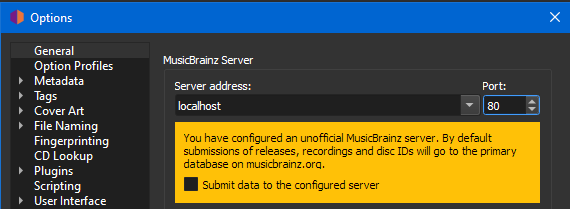
Maybe we should look at the ratecontrol.py file in the Picard source code?
# ============================================================================
# Throttling/congestion avoidance
# ============================================================================

# Throttles requests to a given hostkey by assigning a minimum delay between
# requests in milliseconds.
#

# Plugins may assign limits to their associated service(s) like so:
#
# >>> from picard.webservice import ratecontrol
# >>> ratecontrol.set_minimum_delay(('myservice.org', 80), 100)  # 10 requests/second


# Minimun delay for the given hostkey (in milliseconds), can be set using
# set_minimum_delay()
REQUEST_DELAY_MINIMUM = defaultdict(lambda: 1000)

# Current delay (adaptive) between requests to a given hostkey.
REQUEST_DELAY = defaultdict(lambda: 1000)  # Conservative initial value.

# Determines delay during exponential backoff phase.
REQUEST_DELAY_EXPONENT = defaultdict(lambda: 0)

# Unacknowledged request counter.
#
# Bump this when handing a request to QNetworkManager and trim when receiving
# a response.
CONGESTION_UNACK = defaultdict(lambda: 0)

# Congestion window size in terms of unacked requests.
#
# We're allowed to send up to `int(this)` many requests at a time.
CONGESTION_WINDOW_SIZE = defaultdict(lambda: 1.0)

# Slow start threshold.
#
# After placing this many unacknowledged requests on the wire, switch from
# slow start to congestion avoidance.  (See `_adjust_throttle`.)  Initialized
# upon encountering a temporary error.
CONGESTION_SSTHRESH = defaultdict(lambda: 0)

# Storage of last request times per host key
LAST_REQUEST_TIMES = defaultdict(lambda: 0)