"Karaoke" performance attribute (STYLE-2096)

The “status quo” apparently is that,

  1. An off vocal track in Japan is stored in the database as “karaoke”
  2. An off vocal track in America is stored in the database as “instrumental”
  3. An instrumental cover recording of a song is stored in the database as “instrumental”

This makes both the “karaoke” and “instrumental” attributes on the recording-work relationship meaningless.

  1. Deleting a vocal track from a recording should not be stored in the database two separate ways. Whether the user wants to keep the lyricist and lyrics language in such a case should be a preference in the client.
  2. There should be a way to differentiate an instrumental cover from a deleted vocal track.

Since “karaoke” seems to be a loaded term to people who don’t listen to Japanese music, I’d rename it “off vocal” (to mirror “a capella”) or backing track and use it consistently based on what the music is, not what country the music was made for.

Relationship Style already requires users to listen to the music they’re editing.

1 Like

It does not, as far as I can see :slight_smile: “A basic effort to determine to which tracks the relationship is applicable is appreciated” is the closest I can see to that - but let’s not go into an off-topic discussion.

Your suggestion could generally work if people are really okay with losing the lyrics differentiation - which I don’t personally care much about, but I expect others do since that’s what karaoke was brought in to signify. My main worry is that we will have no idea at all what to use when looking at a release that says “instrumental” - most users, especially beginners, will, well, use “instrumental”, which will turn out to be wrong in many (most?) cases according to your definition.

2 Likes

I won’t pretend I understand everything being said in this topic, but I will say as far as I do, KPop is the same as Japanese music as is being discussed here.

I’m not really familiar with Japanese tracks, and I didn’t know that Karaoke has the broader meaning of a mix with only the vocal part missing.

But I think there is a common understanding of Karaoke being tracks meant to sing along.

I don’t really agree with the very narrow definition of an instrumental only being an instrumental if the vocal part is replaced by some additional instrument line. I have several CDs with instrumental versions of other songs on the album that are the same instrumentation without the vocals. And in most cases I would have a hard time labeling them as “karaoke”. Usually those versions exists to focus on the instrumental part and the melodies of the music, they are often not specifically intended as a sing-along version.

If there needs to be a distinction between “instrumental version with only vocal track removed from the mix” and “instrumental where the vocal part is played by some other instrument” I would instead suggest we have an attribute on the relationship instead.

3 Likes

This doesn’t resolve the inconsistent storage in the database unless you’re saying that the recently implemented "Karaoke" performance attribute (STYLE-2096) should be reverted/converted to your suggestion.

Nothing in my suggestion loses “the lyrics differentiation”.

Deleting a vocal track from a recording should not be stored in the database two separate ways. Whether the user wants to keep the lyricist and lyrics language in such a case should be a preference in the client.

I’m requesting that Style/Relationships be fixed so that the same kind of music is stored the same kind of way in the database. The user can then instruct their client whether recordings using the relationship should keep the lyricist and lyrics language, or blank them out.

If artist intent is that the music is supposed to be listened to without vocals, then the missing/different main melody makes it a significant change that shouldn’t be the same MB Work to be begin with.

As I understand it the Karaoke relationship is for itself useful to mark tracks specifically meant as Karaoke tracks.

Also I think yes, having these attributes could help resolve the inconsistency of having different definitions of instrumental, without being able to distinguish between them. Of course this does not happen automatically and needs to be applied to affected recordings.

But the attempted redefinition of instrumental suggested above also does not resolve anything automatically. It involves changing a whole lot of instrumental tracks to “Karaoke”, which just seems wrong for a lot of cases.

1 Like

That’s another reason why I dislike the idea of relabeling a huge number of existing instrumental versions as “karaoke”. Picard would no longer remove the language and lyricist for them.

As I understood from previous discussions Picard is currently rightfully keeping the language and lyricist for karaoke tracks that are supposed to be sung along. This makes sense to me. But Picard then would not be able to distinguish this specific use case.

2 Likes

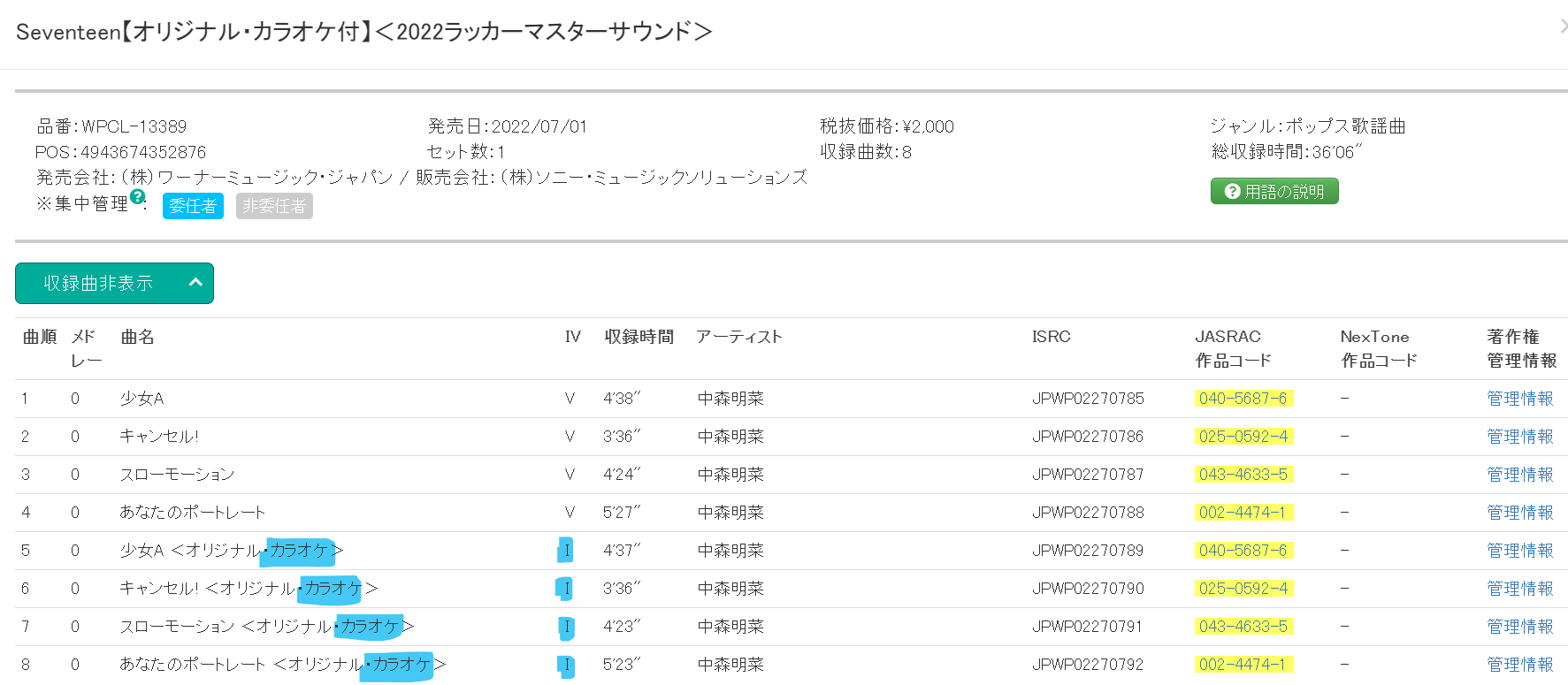
Notice that over there at minc 音楽権利情報検索ナビ (ex-音楽の森 / Music Forest) kind of Japanese ISRC database, each track is marked as either I for インストゥルメンタル (instrumental) or V for ボーカル (vocal), and no other possible values.

Online help:

IV I:インストゥルメンタル, V:ボーカル

Usually, karaoke tracks are marked as I (these are all karaoke tracks or, in other words, recordings with vocal tracks removed from the mix):

I thought sometimes this field was not set, neither I nor V, I didn’t find such examples back, at the moment.

As this site requires an account (free), I show you a screen capture for the first example, with my highlights in blue:

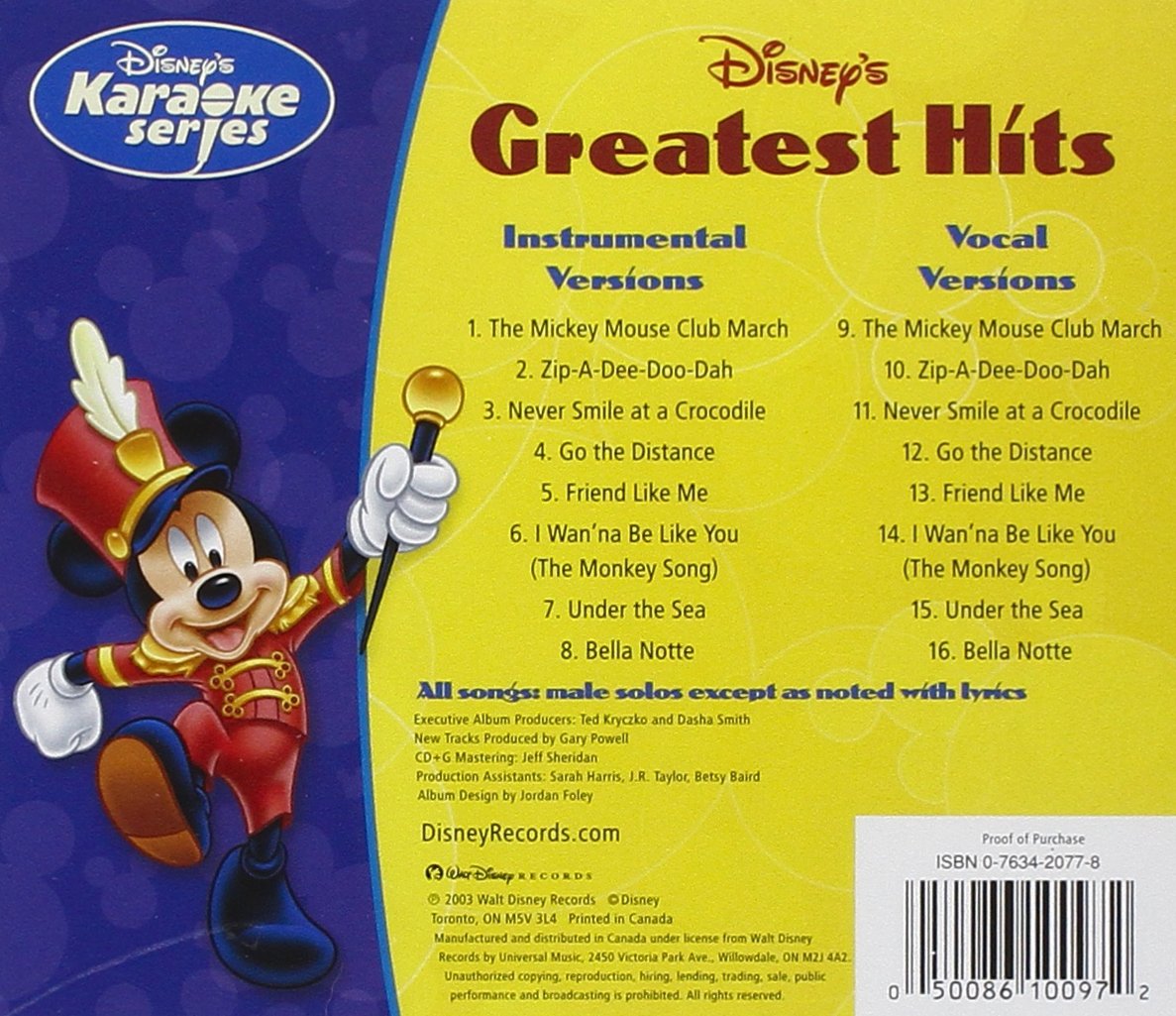
It’s normal in the west for huge mass media companies like Disney to refer to karaoke tracks as “instrumental versions”.

1 Like

And that’s fine - we’ve already said that if the intent is karaoke, that should be set rather than “instrumental”. In this case, this is clearly intended as karaoke and it can be set as such.

5 Likes

Yes, I think Instrumental is ambiguous, and Karaoke is not.

But it seemed that the Karaoke word was an absolute no-go for many editors.

A pity, because this quite famous word was specifically invented to describe this exact kind of recordings, over which you can mix your own lead vocals.

So, we should rename to (or add alternate name) Backing tracks, or something?

1 Like

I think we’re trying to reinvent the wheel.

Many people, including the layman, know what a karaoke track is

3 Likes

But some are reluctant to associate non-Asian backing tracks to the karaoke attribute, and prefer to use instrumental, instead, like the printed version names on the releases themselves.

So maybe something factual like backing tracks would meet more adhesion?

1 Like

honestly, I don’t feel like I even know the “right” way to deal with instrumentals and karaokes anymore, the guidance has changed that much…

I don’t really think that the intent of a recording should have that much weight on how we categorize it (at least in the case of work relationship attributes). all the other attributes are very clear (save for maybe Cover) based simply on listening to the track, but karaoke and instrumental aren’t anymore, especially with the recording relationships using the same words to mean a different thing altogether (confusing many editors in the process, apparently)


to be clear, for the recording relationships, these are currently:

instrumental:

An instrumental version is a version of the song with any vocals removed (for example, a hip hop beat without the rap tracks). For karaoke tracks, use the karaoke relationship.

karaoke:

A karaoke version is a version of the song with the main vocals removed, designed to be used for karaoke. These are generally produced from the original masters by muting the main vocal track or by using post-processing filters to remove the vocals. Karaoke versions can be found labelled in numerous different ways other than “karaoke”: instrumental (even if backing vocals are still present), off vocal, backing track, etc.


whereas the work relationship attributes pages have:

instrumental:

For works that have lyrics, this indicates that those lyrics are not relevant to this recording. Examples include instrumental arrangements, or “beats” from hip-hop songs which may be reused with different lyrics.

karaoke:

This indicates that this is a karaoke recording of the work. This is different from an instrumental recording in that it is actively meant to sing on top of, and as such the lyrics info is still relevant. It might still contain backing vocals and other sections that would not be present in a true instrumental recording.


to me, both pairs of definitions seem to be incompatible with each other, as the work attributes talk about “lyrics [being] relevant to [the] recording”, while the recording relationships overlap quite a bit (especially with karaoke saying that they’re sometimes called instrumentals), except in the cases of an instrumental/karaoke/whatever recording with backing vocals present or a hip-hop beat without the rap

as said, the similar names would almost certainly cause confusion for many editors, both new and old, and I think it would make sense to come up with a new name for some of these relationships/attributes for clarity’s sake


additionally, it would be good to have some clear examples of common cases, including at least:

  • hip-hop and other beats, where the music came first and a different artist wrote and recorded new lyrics (in my mind, this would often imply no involvement between the original beat producer and the lyricist/vocalist. would likely be a recording relationship and a work-work relationship, since multiple rappers and vocalists can use the same beat, like this recording)
  • off-vocal/karaoke/backing tracks, where there are no (or sometimes limited) vocals on a recording of a work with lyrics. these could be pulled from the original recording or new recordings by a different artist (sometimes just a work attribute, occasionally also a recording relationship)
  • instrumental arrangements, where the recording artist doesn’t sing the lyrics, but the melody part is played by an instrument of some sort (almost always a completely original recording, so shouldn’t have a recording relationship, just a work attribute or occasionally a work-work relationship)
6 Likes

Your list is missing the common case where an “instrumentals” version is put out of a release which literally just dropped the vocals from the track and didn’t replace it with anything else. Not aimed at the karaoke market, just at those people who want music without words. (And likely just because it is a cheap way to make a bonus CD \ extra release… :grin: )

1 Like

This case is just the same as @UltimateRiff’s second bullet, it’s just that you don’t want to call it a karaoke:

Where I emphasised pulled from the original recording.

1 Like

This does not describe what these examples are. They are not “backing tracks”. They are recordings without words. This should not mean it defaults to karaoke. Not every band expects you to sing over their music.

I have a few little band releases like this. The band release them as instrumental. They are not releasing them as karaoke. They should be categorised as the band intended.

2 Likes

Erh, yes, if you dropped the vocals from the track, what remains is the backing tracks.
You have removed the melody tracks, what vocals are in a song.
And didn’t replace it with anything else, which means no instruments playing the melody in lieu of the vocals.

You don’t want to call them karaoke, but you don’t want to call them backing tracks, either? :face_with_spiral_eyes:

as Jesus mentioned, that’s my second bullet point

I don’t think it makes sense to treat the same recording treatment (removing the vocal track) differently based solely on artist intent here, as there’s a lot of room for confusion if we do. is there any difference between a karaoke and “instrumentals” track when there’s only a lead vocal part? they could both be labeled as (instrumental), as mentioned in one of the karaoke definitions mentioned above

1 Like