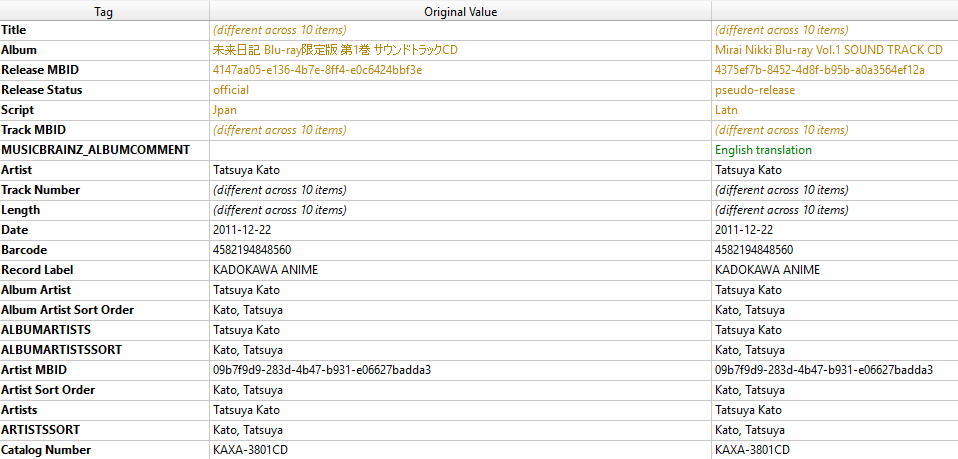
I got a lot of Japanese music, but I am not too familiar with reading Japanese.
To make it easier for me to search for music I previously used translated use pseudo-releases, but I find it annoying that pseudo-releases are often missing art/date etc.
I am trying to understand if I can use aliases to work together with Picard tagging.
This alias is useful for users who cannot read Japanese characters and want to search their music library using Latin script. However, when Picard tags my files, only the canonical/original title is written to the tags:
TITLE: 君の街まで
The alias does not appear to be written into any searchable tag field, so in players like Foobar2000 cannot search for: “Kimi no Machi Made” unless I manually add my own custom tags.
What’s the best approach to this?
I read this post from last year, but it did not give any advice on how to tackle this until Picard version 3 comes out.
Yes, it does. Otherwise the situation is as in the discussion you linked to: Picard will be able to use release and recording title aliases for offering translated titles. I’m personally quite excited about this change and have used it on several releases. But likely we will need to improve this further.