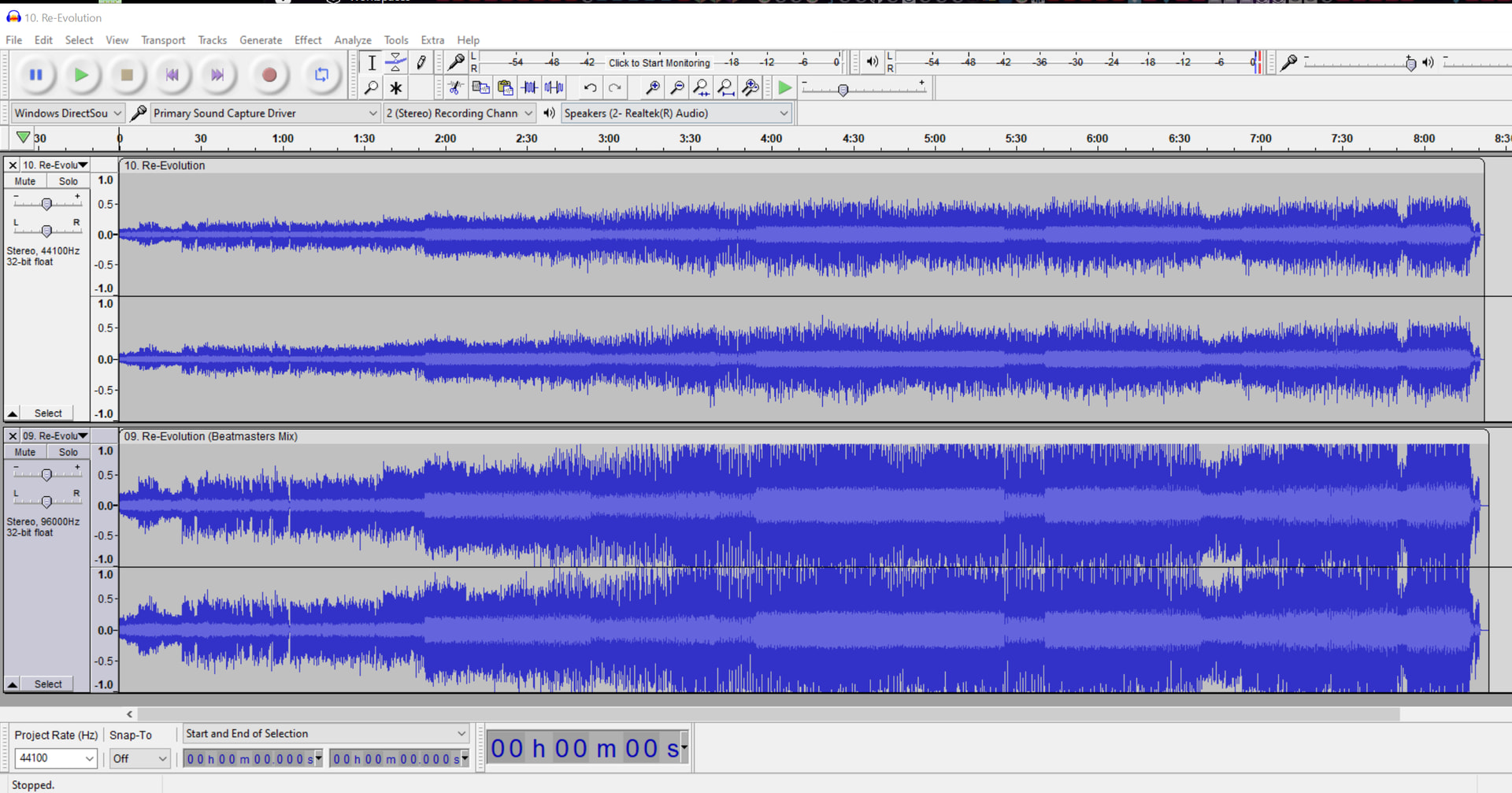
Yes. The recording is the same. It has just been mastered differently. i.e. just had the volume slammed up in the “loudness wars”. In the MB world this is the same recording as it is still the same. MB does not take different mastering as a difference. It only takes a different mix as different. They need to sound different.
I put two track like this into Audacity to look at. Lets you play them both together.
In your example, the sound begins to get clipped.
Maybe in this case and in the case of compressing, we should keep recordings separate?
But it’s hard to maintain over the years, with later releases. Knowing which recording was used.
It is a classic example of a remastered compilation pushing the volume up. MB calls it mastering and does not like to separate it. It is why some older CDs can sound so much better than newer ones.
I will merge some recordings later when I get time and motivation. There is a bit to unpack. I have them on hand with dates, barcodes, ISRC, covers, loudness and songwriters. But it is a bit much. Different durations sometimes, instruments, singing, sound effects. I think I will add “vocals” and “flute” to the disambiguation.
Not respecting loudness makes it easier, because I might not have both editions. I guess everything in this group should be same recordings from vinyl, despite some bonus tracks being in the hall of shame of mastering.
You can embed images direct into this forum. Just drag and drop them onto the post. Putting them on sites like imgur.com means not everyone gets to see them. They geo-block for many countries.
Don’t worry about this. You don’t have to merge stuff, just nice to do if you have the time. No one expects this to happen. Even if a few notes are left about the versions someone else may do it.
This is often the case with Release Groups. Same recordings tend to be on all the releases, and even a “remaster 20th edition” tends to just be a bit of faffing with audio levels. Still that same source recording.
Would significant differences in duration make different “recordings” such as 5:10 vs 5:46, and 3:51 vs 4:22. The actual differences in sound are unknown because I only have one edition. Likely an earlier fadeout and and a longer section of field recording mixed in.
If there’s a difference of more than 15 seconds, track lengths of recordings to be merged will be highlighted (red). Usually they should not be merged and even differences of 10 seconds and less should have a closer look.
Only if the difference in length is solely due to added silence is it the same recording.
An appended interlude section (whatever it is), makes it a different recording.
Early fades are considered the same recording, if it’s about a few seconds (also depends on total length). Half a minute is definitely too much of a difference for the same recording.
This is also a classic example of why ISRCs can’t be used for merges. Often the album and single ISRCs get swapped around on a compilation. Or using an ISRC of a 7" for a 12". That error usually stands out with the lengths.
Bad merges are hard to unmerge. So best to skip them if you are unsure.
That’s an edge case. The versions are audibly different, but not because of a different mix. Swapped channels are actually a mastering error, and different mastering is not considered a different recording according to the guidelines.
Of course, one could argue that swapped channels are also a different mix, created by the mastering engineer.
I looked up another famous example. In that case, it was decided that John Dent and Bob Ludwig masterings contain the same recordings.
Which is somehow good decision, for us editors. This way, it’s just a release annotation, once we know.
But otherwise, it’s difficult and maybe not so much value to maintain a whole new set of recordings for swapped channels…
If you decide to split swapped channels, what would you write in the disambiguation so that someone in the future knows which recording to pick? Something like “guitar in the left channel”?
I wouldn’t do that, and in most cases that’s probably best. (see above)
It’s certainly a separate release and you could write “swapped channels” as disambiguation comment, if there’s nothing else to distinguish it from other releases with correct channels. In my Dire Straits example, the are other, more obvious things (a different mastering engineer in the booklet).
I am always ripping my CDs with whipper. It gives you an easy way to submit new disc IDs, or add some data to the disc ID edit or release. If there isn’t any version of the release at all, I usually try to find one from streaming sites, import it with Harmony, and use that as the base for the CD version. Both may have different ISRCs.
Before running whipper, I always run the following apps to get nice overview of the CD data on terminal.
Sometimes the reading has transparent errors on one of the drives and you get duplicates.
Sometimes there are duplicates on disc (e.g. original song had a hidden bonus track and thus had only one ISRC, and now it is split to two tracks with same ISRC).
Kepstin’s magicISRC shows those immediately.