The main function of this userscript (at least, how I use it), is that it will auto-pick the first suggested matched recordings in the recording tab, when adding a release.
Where this is extremely useful is when you are adding seemingly identical releases, e.g. different digital releases, where you would otherwise be re-using an existing medium.
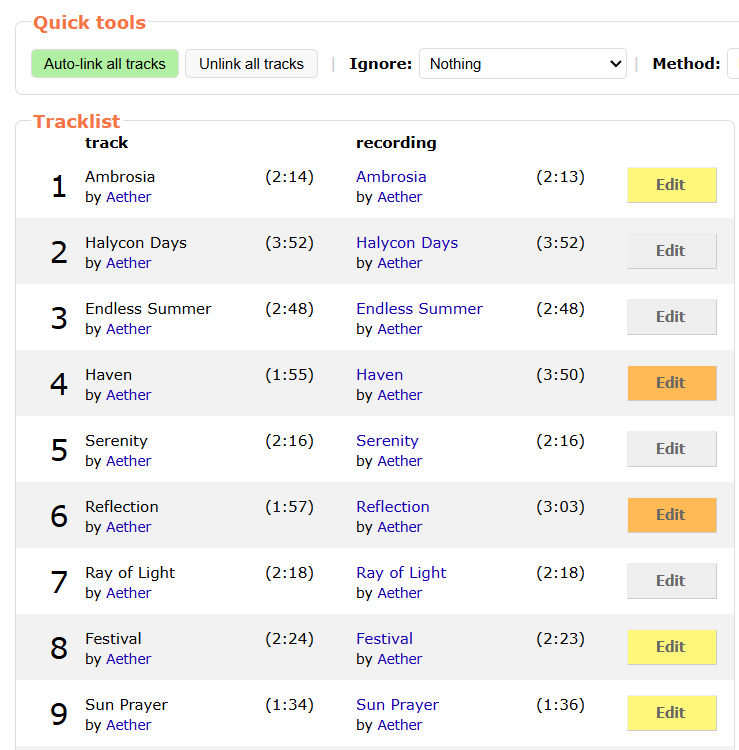
Here is an example where I previously would have re-used an existing tracklist, but there are actually some sneaky (large) time differences:
It pains me to think of mistakes I would have made in the past - because it’s very hard (impossible?) to accurately scan and compare track times across two tracklists, just using just your squishy eye and brain balls.
I’m giving this userscript a plug to try soothe the guilt
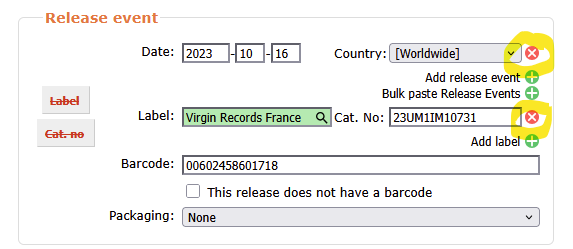
These are properties that do not have an end-date or ended property.
As it stands now, I have to disable the script if I want to completely remove a release event (date+country pairing) or label.
Not a good idea to add Soulseek sourced DiscIDs. As can be seen in that example you show, there are already bogus DiscIDs on that release. Problem with Soulseek\Torrents\etc is often the artwork is sourced from somewhere different to the rip.
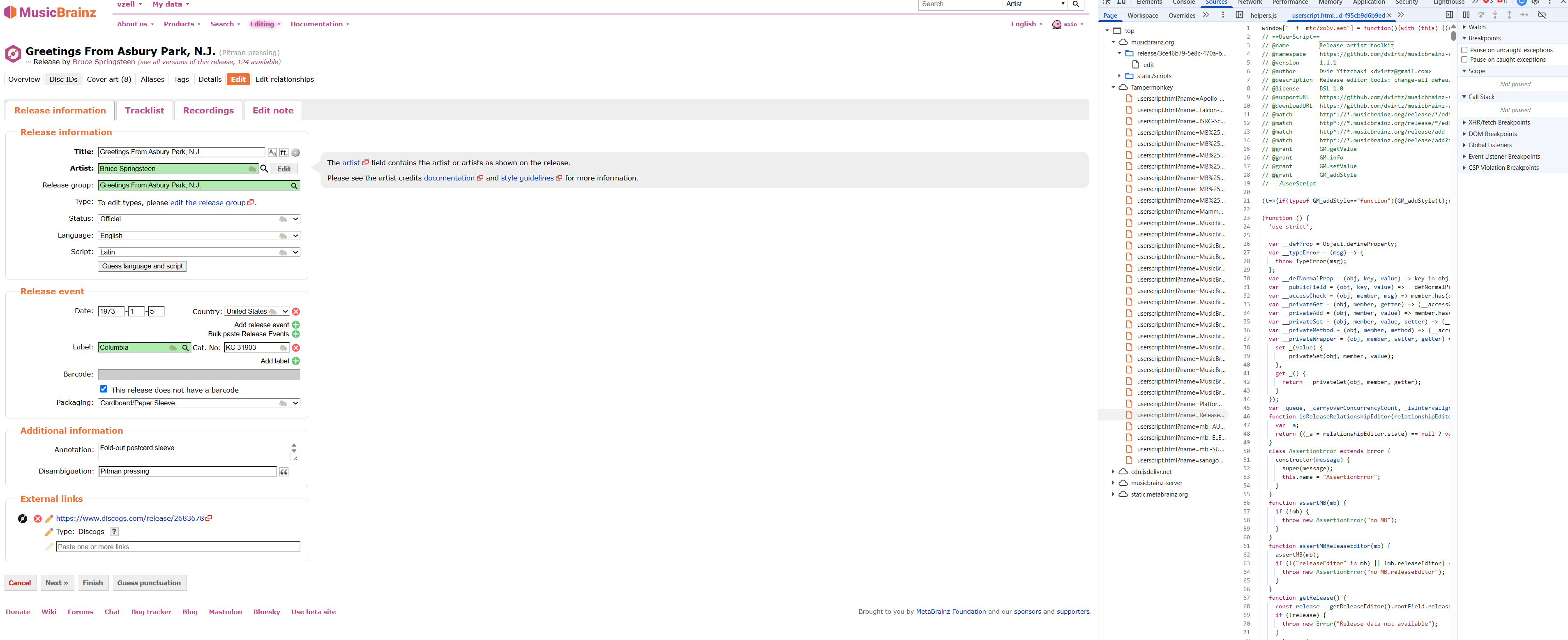
Actually I assume that image is mocked up? CD1 is impossible as it should be impossible to have a DiscID with 15 and 16 tracks attached to the same release?
That is on test.musicbrainz and was… testing
You can add bogus stuff anywhere if you are not careful.
Problem with Soulseek\Torrents\etc is often the artwork is sourced from somewhere different to the rip.
We have crc stuff too. In any case, this is already possible with Picard (which I used so far), this is exactly the same but from MB (so its way faster then starting picard, hunting menu item and so on). So if you think this is generally not OK, you should complain at Picard first. But this is such a niche feature that I doubt many people will use it. I didn’t know about disk id myself at all until I starting userscript development.
CD1 is impossible as it should be impossible to have a DiscID with 15 and 16 tracks attached to the same release?
Obviously possible as this is test. Script complains that there is a difference but it allows to “add it anyway”.
I did wonder how you managed to do that. Now I understand
It is not the tool, it is how they are used. I have a heap of music from torrents. So I am not complaining as to how data gets into Musicbrainz. I am just talking from experience that we all know something that sits on the file sharing networks are often compiled from multiple sources.
I’ve had 15 track rips with artwork sourced from discogs showing 14 track versions. After a bit of digging I could tell the person who had ripped the discography had done a good job on the rips, but didn’t worry about matching artwork to versions. From that day onwards I stopped submitting DiscIDs and AcoustIDs from torrents.
The more you spend time with DiscIDs the more you recognise the differences.
I know we have a difference of opinion on quality control. I just think it is being fair to the MB database to not submit data that you are unsure as to the source 100%.
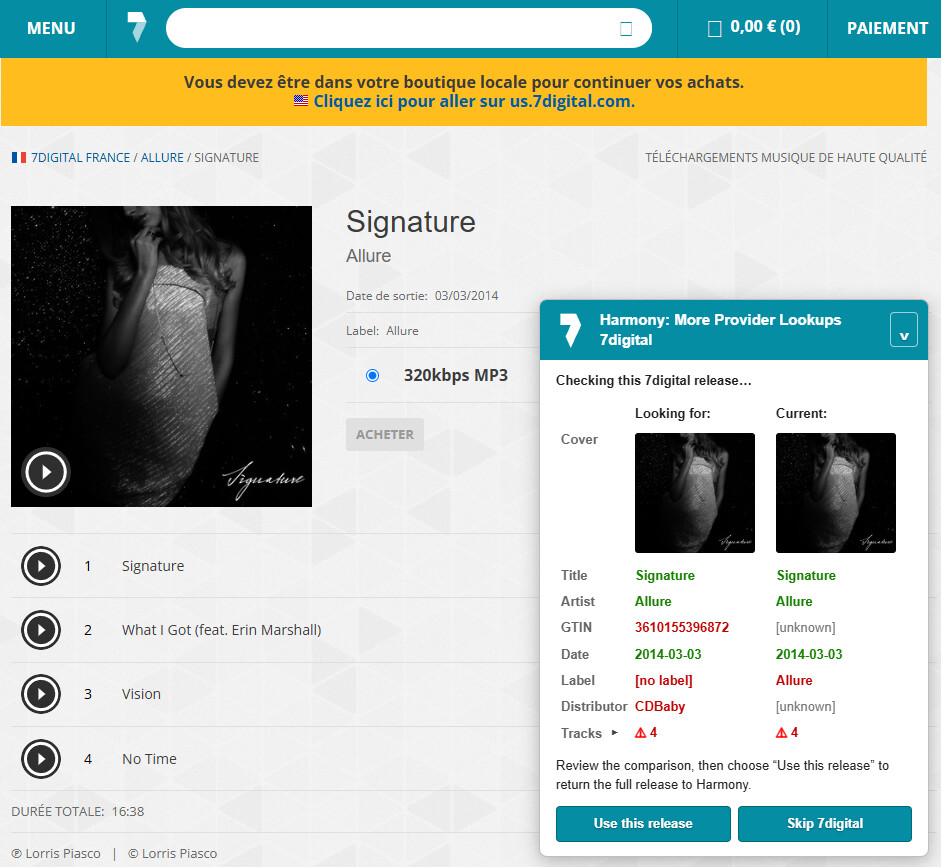
Just for fun and to see how feasible it is, I have been working on a userscript that acts as a plug-in for Harmony to add integration for a bunch more providers. It’s based heavily on what I did to restore Beatport functionality to Harmony, but expanded in scope to other native and non-native providers.
Right now it supports Bandcamp, Traxsource, Youtube Music, SoundCloud, 7digital, and it would be easy to add more.
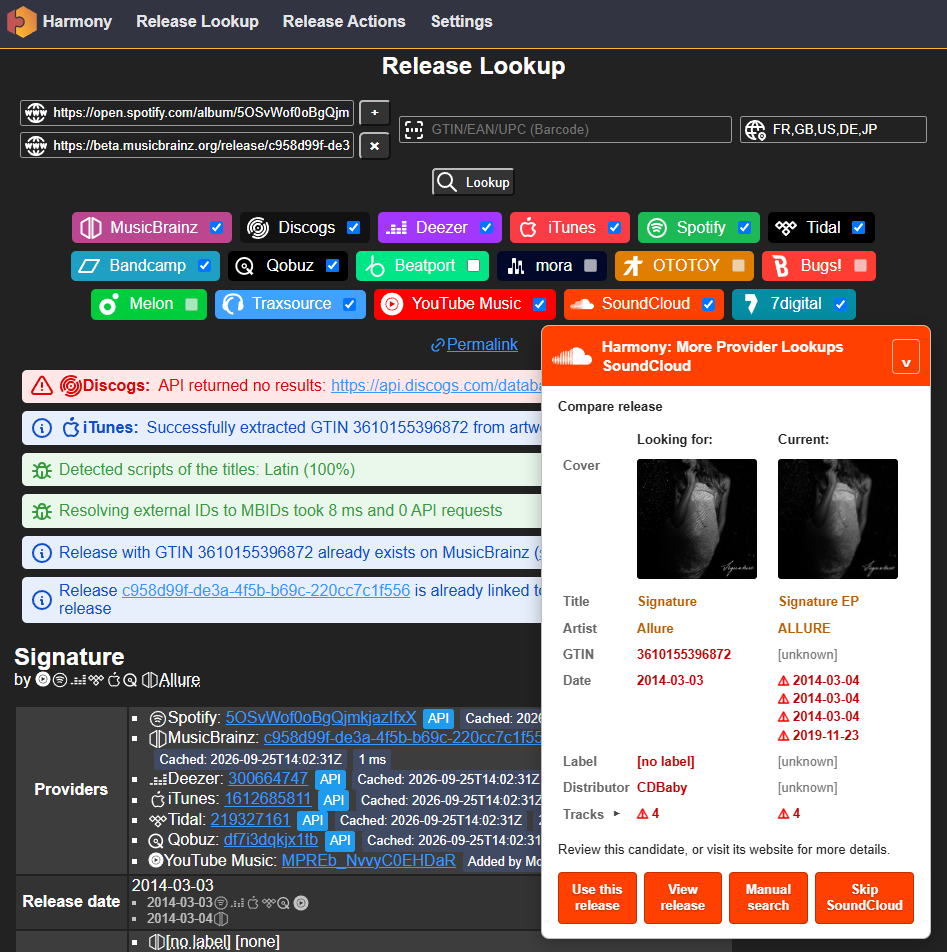
What it does is send background HTML requests to these sites to search for artist+title or barcode if supported and then if it finds a decent match, it presents you a comparison in a helper panel within Harmony. From there you can review the information and either add it, skip it, check the webpage for more info, or do a manual search. The panel will follow you to the website while you browse and show you live comparison info on the current page and let you accept or skip from there as well. It will also passively cache releases while you browse these sites to avoid making network requests when possible.
Accepting a release from a native provider will add it to the native harmony search and reload the lookup, accepting from a non-native provider will inject the information into Harmony’s UI where you can then review it a second time before importing to MB.
I am hoping to hear some opinions on this idea because I am unsure if I want to release it at all, for a couple reasons:
On some of these sites the GTIN is rarely or never available, and I know for some people that means a release from that provider can never be definitively matched to a release with a GTIN. If a lot of people have that opinion then I could remove providers that have no GTIN (7digital) and prevent adding releases that have unknown GTIN. Right now Harmony itself is happy to let you merge a Bandcamp page with [unknown] barcode into a release with a barcode so that is the functionality I was mimicking.
Less knowledgeable users may blindly click “Use this release” on every result. and thus be empowered to add more garbage, faster. It does combat this by disallowing a release to be used at all if it is obviously not a match (like if track lengths are too dissimilar, or track counts don’t match, or there are 2 barcodes that don’t match. But I don’t know if that is enough and I don’t want to release it if it is going to do more harm than good.
7digital releases can be found by actually just searching the complete barcode (including any leading zeroes) in the search field and it will return the corresponding release.