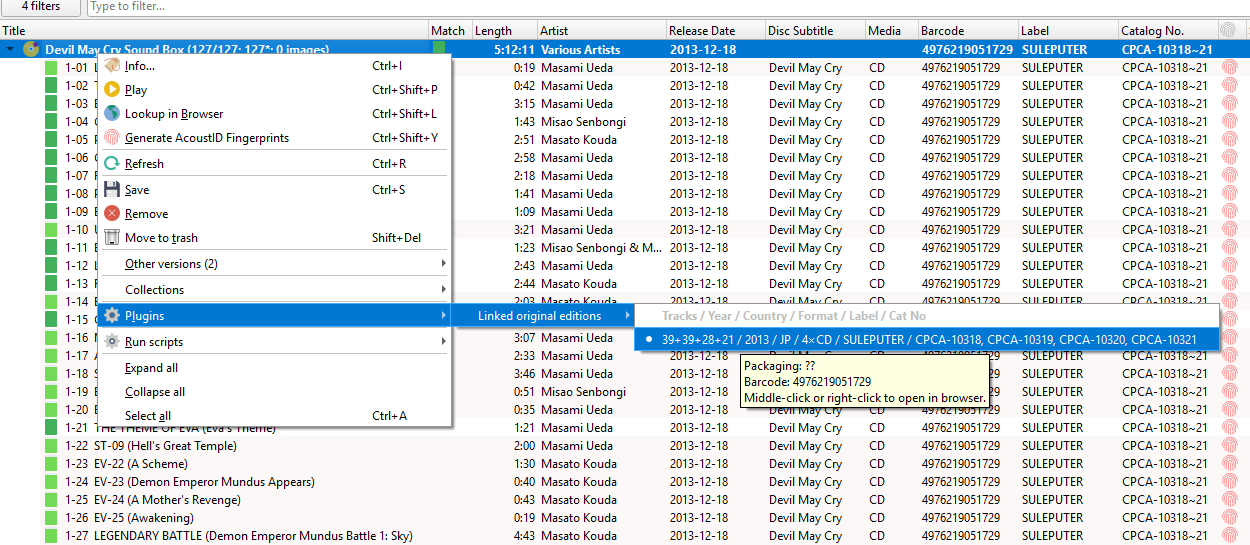
I’m not really sure how to properly publish the plugin like it would mean making a github page and maintaining it and it’s too many things to think about so i just kept to myself cause it did the job for me and I didn’t think people would be interested all that much.
I also wanted to improve it more since it still requires you to copy paste the release url manually from a browser instead of just giving you options within Picard itself. Not to mention it probably won’t work Picard 3. Also the whole thing is vibe coded by Gemini since I’m not an expert on making these kind of things.
But for now the best I can do is just paste the whole thing from the .py file called “latin_pseudo_overlay.py”. Maybe someone can turn this into a real plugin or actually implement it in Picard for real.
import re
import traceback
from functools import partial

try:
    from PyQt5.QtWidgets import QInputDialog, QMessageBox
except ImportError:
    try:
        from PyQt6.QtWidgets import QInputDialog, QMessageBox
    except ImportError:
        from picard.ui.compat import QInputDialog, QMessageBox

from picard.album import Album
from picard.track import Track
from picard.ui.itemviews import (
    BaseAction,
    register_album_action,
    register_track_action,
)

PLUGIN_NAME = "Latin Pseudo-Release Overlay"
PLUGIN_AUTHOR = "Custom"
PLUGIN_DESCRIPTION = (
    "Prompts for a MusicBrainz Pseudo-Release URL or MBID and overlays Latin script "
    "album title, artist names, and track titles onto an official release while "
    "preserving all official metadata (dates, country, cover art, streaming links, MBIDs)."
)
PLUGIN_VERSION = "1.5"
PLUGIN_API_VERSIONS = [
    "2.0", "2.1", "2.2", "2.3", "2.4", "2.5", "2.6", "2.7", "2.8", "2.9",
    "2.10", "2.11", "2.12", "2.13", "3.0"
]
PLUGIN_LICENSE = "GPL-2.0-or-later"


def parse_artist_credit(artist_credit_data):
    """
    Parses a MusicBrainz artist-credit list structure into:
      - Formatted artist string with join phrases (e.g., 'Artist A feat. Artist B')
      - Formatted artist sort string with join phrases
      - List of individual credited artist names
    """
    if not artist_credit_data:
        return "", "", []

    credit_parts = []
    sort_parts = []
    artist_names = []

    for item in artist_credit_data:
        if isinstance(item, dict):
            name = item.get("name")
            artist_obj = item.get("artist", {})
            if not name:
                name = artist_obj.get("name", "")
            sort_name = artist_obj.get("sort-name") or name
            join_phrase = item.get("joinphrase", "")

            if name:
                artist_names.append(name)
                credit_parts.append(name + join_phrase)
                sort_parts.append(sort_name + join_phrase)
        elif isinstance(item, str):
            artist_names.append(item)
            credit_parts.append(item)
            sort_parts.append(item)

    return "".join(credit_parts), "".join(sort_parts), artist_names


def update_metadata_dict(metadata_obj, key, value):
    """Safely updates a Picard Metadata object or dictionary."""
    if metadata_obj is not None and value:
        metadata_obj[key] = value


class LatinPseudoOverlayAction(BaseAction):
    NAME = "Apply Latin pseudo overlay..."

    def callback(self, objs):
        if not objs:
            return

        # 1. Pop up input dialog window
        text, ok = QInputDialog.getText(
            self.tagger.window,
            "Latin Pseudo-Release Overlay",
            "Paste the MusicBrainz Pseudo-Release URL or MBID:"
        )

        if not ok or not text.strip():
            return

        # 2. Extract 36-character MBID from input
        mbid_match = re.search(
            r'[0-9a-f]{8}-[0-9a-f]{4}-[0-9a-f]{4}-[0-9a-f]{4}-[0-9a-f]{12}',
            text.strip(),
            re.I
        )
        if not mbid_match:
            QMessageBox.warning(
                self.tagger.window,
                "Invalid Input",
                "Could not find a valid MusicBrainz Release ID (MBID) in the provided text."
            )
            return

        release_id = mbid_match.group(0)

        # 3. Fetch pseudo-release metadata via Picard's MusicBrainz API
        callback_handler = partial(self._on_release_fetched, target_objs=objs)
        self.tagger.mb_api.get_release_by_id(
            release_id,
            callback_handler,
            inc=['release-groups', 'media', 'recordings', 'artists', 'artist-credits']
        )

    def _on_release_fetched(self, document, http, error, target_objs=None):
        try:
            if error or not document:
                QMessageBox.warning(
                    self.tagger.window,
                    "Fetch Error",
                    f"Failed to retrieve pseudo-release metadata from MusicBrainz.\n\nError: {error or 'Empty response'}"
                )
                return

            # Handle direct dictionary vs nested release key
            if isinstance(document, dict) and 'release' in document:
                release = document['release']
            elif isinstance(document, dict):
                release = document
            else:
                QMessageBox.warning(
                    self.tagger.window,
                    "Fetch Error",
                    "Unexpected metadata format received from MusicBrainz."
                )
                return

            pseudo_album_title = release.get('title', '')
            pseudo_album_artist, pseudo_album_artistsort, pseudo_album_artists = parse_artist_credit(
                release.get('artist-credit', [])
            )

            # Build medium & track lookups from pseudo-release
            # 1) By (disc_number, track_number)
            # 2) Flat sequential list as fallback
            pseudo_tracks_by_pos = {}
            pseudo_tracks_flat = []

            for med_idx, medium in enumerate(release.get('media', []), start=1):
                med_pos = medium.get('position', med_idx)
                for trk_idx, trk in enumerate(medium.get('tracks', []), start=1):
                    trk_pos = trk.get('position', trk_idx)
                    pseudo_tracks_by_pos[(med_pos, trk_pos)] = trk
                    pseudo_tracks_flat.append(trk)

            if not target_objs:
                target_objs = []

            # Group target items into albums & individual tracks
            albums_to_update = set()
            tracks_to_process = []

            for obj in target_objs:
                if isinstance(obj, Album):
                    albums_to_update.add(obj)
                    album_tracks = getattr(obj, 'tracks', [])
                    for trk_obj in album_tracks:
                        tracks_to_process.append((obj, trk_obj))
                elif isinstance(obj, Track):
                    parent_album = getattr(obj, 'album', None)
                    if parent_album and isinstance(parent_album, Album):
                        albums_to_update.add(parent_album)
                    tracks_to_process.append((parent_album, obj))

            # 1. Update Album-level metadata (both active metadata and orig_metadata)
            for album in albums_to_update:
                for meta_target in (getattr(album, 'metadata', None), getattr(album, 'orig_metadata', None)):
                    if meta_target is None:
                        continue
                    if pseudo_album_title:
                        meta_target['album'] = pseudo_album_title
                    if pseudo_album_artist:
                        meta_target['albumartist'] = pseudo_album_artist
                        meta_target['artist'] = pseudo_album_artist
                    if pseudo_album_artistsort:
                        meta_target['albumartistsort'] = pseudo_album_artistsort
                    if pseudo_album_artists:
                        meta_target['albumartists'] = pseudo_album_artists
                        meta_target['artists'] = pseudo_album_artists

            # 2. Update Track-level metadata & attached file metadata
            updated_tracks_count = 0
            total_tracks_target = len(tracks_to_process)

            for trk_idx, (parent_album, trk) in enumerate(tracks_to_process):
                disc_num = None
                track_num = None

                try:
                    disc_num = int(trk.metadata.get('discnumber', '1'))
                except (ValueError, TypeError):
                    pass

                try:
                    track_num = int(trk.metadata.get('tracknumber', '1'))
                except (ValueError, TypeError):
                    pass

                source_trk = None
                if disc_num is not None and track_num is not None:
                    source_trk = pseudo_tracks_by_pos.get((disc_num, track_num))

                if not source_trk and trk_idx < len(pseudo_tracks_flat):
                    source_trk = pseudo_tracks_flat[trk_idx]

                if source_trk:
                    # Track Title: Prioritize track title over recording title for pseudo-releases
                    source_title = source_trk.get('title')
                    if not source_title and 'recording' in source_trk:
                        source_title = source_trk['recording'].get('title')

                    # Parse Track Artist Credits
                    trk_artist_credit = source_trk.get('artist-credit')
                    if trk_artist_credit:
                        t_artist, t_artistsort, t_artists = parse_artist_credit(trk_artist_credit)
                    else:
                        t_artist, t_artistsort, t_artists = (
                            pseudo_album_artist, pseudo_album_artistsort, pseudo_album_artists
                        )

                    # Apply to both trk.metadata and trk.orig_metadata so Picard scripts & file updater use them
                    for meta_target in (getattr(trk, 'metadata', None), getattr(trk, 'orig_metadata', None)):
                        if meta_target is None:
                            continue
                        if source_title:
                            meta_target['title'] = source_title
                        if pseudo_album_title:
                            meta_target['album'] = pseudo_album_title
                        if pseudo_album_artist:
                            meta_target['albumartist'] = pseudo_album_artist
                        if pseudo_album_artistsort:
                            meta_target['albumartistsort'] = pseudo_album_artistsort
                        if pseudo_album_artists:
                            meta_target['albumartists'] = pseudo_album_artists
                        if t_artist:
                            meta_target['artist'] = t_artist
                        if t_artistsort:
                            meta_target['artistsort'] = t_artistsort
                        if t_artists:
                            meta_target['artists'] = t_artists

                    # Gather all attached audio files for this track
                    attached_files = []
                    if hasattr(trk, 'iterfiles'):
                        try:
                            attached_files.extend(list(trk.iterfiles()))
                        except Exception:
                            pass
                    if hasattr(trk, 'linked_files'):
                        try:
                            for f in trk.linked_files:
                                if f not in attached_files:
                                    attached_files.append(f)
                        except Exception:
                            pass

                    # Apply updated metadata directly to each attached file
                    for f in attached_files:
                        if hasattr(f, 'metadata') and f.metadata is not None:
                            if source_title:
                                f.metadata['title'] = source_title
                            if pseudo_album_title:
                                f.metadata['album'] = pseudo_album_title
                            if pseudo_album_artist:
                                f.metadata['albumartist'] = pseudo_album_artist
                            if pseudo_album_artistsort:
                                f.metadata['albumartistsort'] = pseudo_album_artistsort
                            if pseudo_album_artists:
                                f.metadata['albumartists'] = pseudo_album_artists
                            if t_artist:
                                f.metadata['artist'] = t_artist
                            if t_artistsort:
                                f.metadata['artistsort'] = t_artistsort
                            if t_artists:
                                f.metadata['artists'] = t_artists

                        # If Picard has update_file_metadata on Track, run it to sync tags
                        if hasattr(trk, 'update_file_metadata'):
                            try:
                                trk.update_file_metadata(f)
                            except Exception:
                                pass

                        try:
                            f.update()
                        except Exception:
                            pass

                    try:
                        trk.update()
                    except Exception:
                        pass

                    updated_tracks_count += 1

            # Refresh all updated album UI representations
            for album in albums_to_update:
                try:
                    album.update(update_tracks=True, update_selection=True)
                except TypeError:
                    try:
                        album.update()
                    except Exception:
                        pass
                except Exception:
                    pass

            # Force Picard's bottom metadata comparison box to refresh its New Value display
            try:
                if hasattr(self.tagger, 'window') and hasattr(self.tagger.window, 'metadata_box'):
                    self.tagger.window.metadata_box.update()
            except Exception:
                pass

            # Confirmation feedback to user
            msg = (
                f"Successfully applied Latin pseudo-release overlay!\n\n"
                f"Overlay Album Title: {pseudo_album_title}\n"
                f"Overlay Artist: {pseudo_album_artist}\n"
                f"Tracks Updated: {updated_tracks_count} of {total_tracks_target}"
            )
            QMessageBox.information(self.tagger.window, "Latin Overlay Applied", msg)

        except Exception as e:
            err_details = traceback.format_exc()
            QMessageBox.critical(
                self.tagger.window,
                "Overlay Error",
                f"An error occurred while applying the overlay:\n\n{e}\n\n{err_details}"
            )


register_album_action(LatinPseudoOverlayAction())
register_track_action(LatinPseudoOverlayAction())